


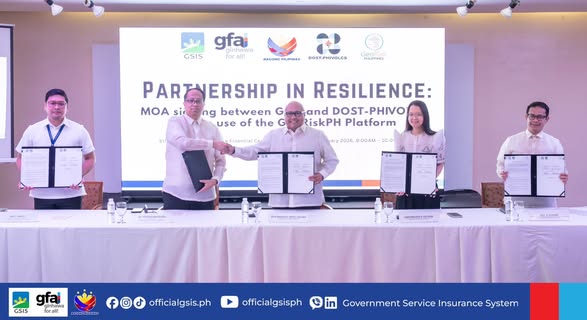
The Government Service Insurance System (GSIS) has officially entered into a landmark Memorandum of Agreement (MOA) with the Philippine Institute of Volcanology and Seismology (PHIVOLCS), marking a significant leap forward in the nation’s disaster risk management and insurance capabilities.
The partnership grants GSIS full access to the GeoRiskPH platform, the Philippines’ premier central hub for hazard and risk information. This integration allows GSIS to leverage high-resolution, science-based data to evaluate the vulnerability of government infrastructure against natural calamities.
Through this collaboration, GSIS is shifting toward a more data-driven approach to insurance. By utilizing GeoRiskPH’s comprehensive mapping of seismic, volcanic, and hydro-meteorological hazards, the pension fund can now conduct highly precise risk assessments for public assets, including schools, hospitals, bridges, and government offices. “As the insurer of government properties, this allows us to conduct better and more precise risk assessments to safeguard public assets and protect the welfare of our members and pensioners,” said GSIS President and General Manager Wick Veloso during the signing ceremony. “We are not just insuring buildings; we are ensuring the continuity of essential public services.”
The integration of GeoRiskPH into GSIS operations provides three critical advantages:
-
Enhanced Risk Modeling: Improved accuracy in calculating insurance premiums and coverage limits based on specific geographic vulnerabilities.
-
Faster Disaster Response: Streamlined identification of affected assets following natural disasters, enabling quicker claims processing.
-
Strategic Asset Management: Data-backed insights that help the government prioritize retrofitting and disaster-mitigation efforts for high-risk structures.
This initiative underscores the GSIS commitment to the national agenda of climate and disaster resilience. By bridging the gap between scientific research and financial protection, GSIS and PHIVOLCS are creating a blueprint for how state agencies can collaborate to shield the economy from the volatile effects of natural hazards.
The move ensures that public funds entrusted to GSIS are managed with the highest level of diligence, safeguarding the “Ginhawa” (comfort) of its members even in the face of adversity.

