


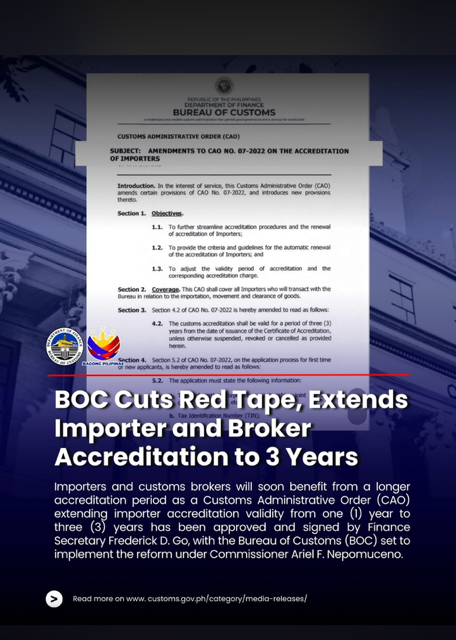
To ensure accountability and continuous compliance, importers will be required to submit an Annual Reportorial Compliance (ARC) within 30 days from their accreditation anniversary. Failure to comply may result in suspension or revocation. Renewal applications with complete documents will be processed through the Customer Care Portal System (CCPS) within seven working days, further improving efficiency.
This reform complements existing policies, including CAO 5-2019 which likewise provides 3-year registration validity for customs brokers, further aligning accreditation frameworks across key players in the import process and reinforcing a more cohesive and streamlined customs regulatory environment.
Introduced by Commissioner Nepomuceno in 2025, the reform supports President Ferdinand R. Marcos Jr.’s directive to reduce red tape, improve ease of doing business, and strengthen trade competitiveness, with the Department of Finance backing the measure as part of broader efforts to streamline government processes.
Red tape
Through this reform, the BOC will deliver faster, simpler, and more reliable services for businesses and stakeholders by reducing repetitive requirements and improving overall transaction efficiency.
Previously, importer accreditation was valid for only one year, requiring annual renewals, repeated document submissions, and multiple compliance steps. These processes resulted in delays, increased administrative costs, and added burden on importers.
By listening to stakeholders and public sentiments, the BOC introduced this policy transformation to address these challenges. The new CAO reduces repetitive processes, lowers compliance costs, and simplifies procedures, resulting in a more efficient and predictable system.
“These reforms reflect the kind of service we are building at the Bureau, grounded in integrity, driven by accountability, and enabled by modernization. We listened to our stakeholders and the public, and we acted. We are removing unnecessary burdens on compliant importers while strengthening our systems to ensure transparency and fairness. Our commitment is clear. Efficient, predictable, and people-centered customs service that businesses can trust and the public can rely on,” Nepomuceno said.
Finance Secretary Go emphasized the importance of the reform in supporting business growth and improving trade systems. “By extending the validity of importer accreditation, we are reducing red tape and enabling a more efficient trade system that can meet growing consumer demand and support local industries. This reform allows businesses to focus more on operations and growth rather than administrative requirements,” Secretary Go said.
The CAO will take effect 15 days after its complete publication in the Official Gazette or in a newspaper of general circulation.
Developed through consultations with stakeholders, the reforms reflect the Bureau’s commitment to responsive governance. These measures advance the BOC’s IAM program, Integrity, Accountability, and Modernization, by promoting transparency, enforcing compliance, and delivering modern, efficient customs services that directly benefit the Filipino people.

