


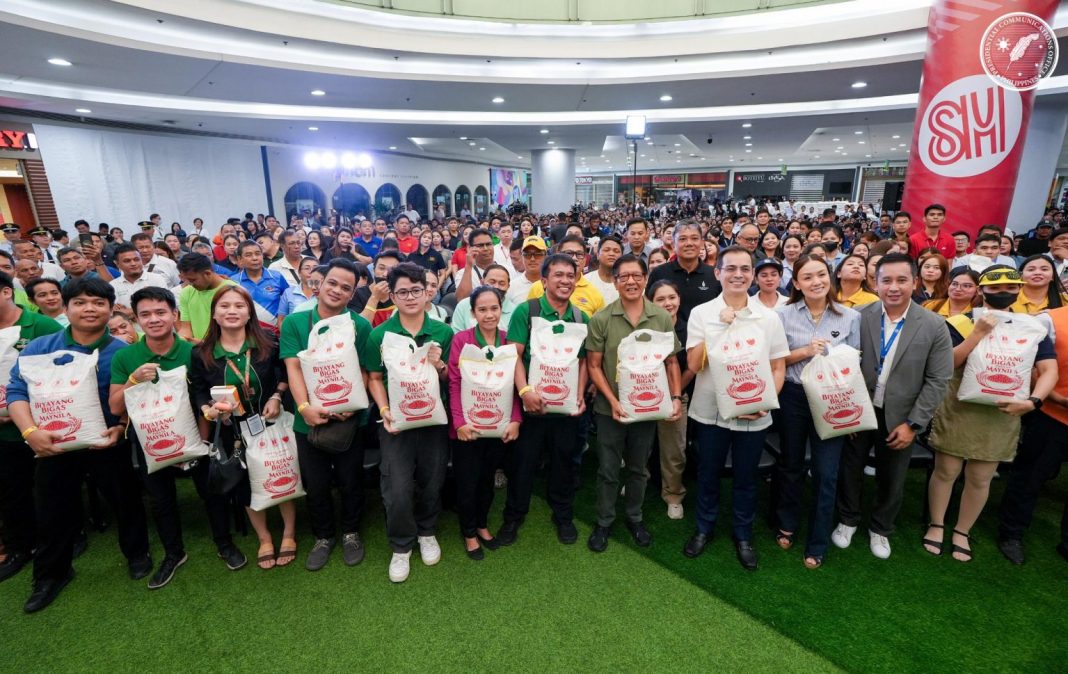
President Ferdinand R. Marcos Jr. reaffirmed his administration’s commitment to a hunger-free Philippines during the launch of the “Biyayang Bigas para sa Maynila” program held Thursday at SM City Manila.
The initiative, a strategic partnership between the National Government and the City Government of Manila, serves as the pilot for a nationwide effort to provide immediate food relief to vulnerable sectors while stabilizing the domestic agricultural economy.
In his keynote address, President Marcos emphasized that food security is the cornerstone of his administration’s legacy.
“Sabi ko, sana pagbaba ko bilang Pangulo ay masasabi kong wala nang gutom na Pilipino. Kaya po aming ginagawa, patuloy na ginagawa ito,” the President stated. (“I said, I hope that by the time I step down as President, I can say there are no more hungry Filipinos. That is why we are doing this, and why we will continue to do this.”)
The President noted that while the program begins in the capital, the ultimate goal is to scale the distribution to cover the entire country, ensuring that no Filipino family is left behind.
The launch comes at a critical time as the ongoing conflict in the Middle East continues to drive up global fuel prices, subsequently inflating the cost of basic commodities. President Marcos acknowledged that while the government cannot control international oil markets, it can—and will—take decisive action to protect the people from rising food costs.
-
Strategic Intervention: The program acts as a buffer against inflation for the most vulnerable sectors.
-
Direct Assistance: By providing rice subsidies, the government reduces the financial burden on low-income families.
-
Local Support: The initiative simultaneously supports local farmers by integrating them into the government’s food supply chain.
The “Biyayang Bigas para sa Maynila” is funded through a P286 million allocation from the Office of the President via the Financial Assistance to Local Government Units (FALGU) program.
| Detail | Impact |
| Total Beneficiaries | 80,000 workers and residents in Manila |
| Subsidy Amount | 10 kilos of rice per beneficiary |
| Frequency | Six (6) distributions within one year |
| Total National Investment | ~P15 Billion released to date for similar initiatives |
By collaborating directly with Local Government Units (LGUs), the administration has eliminated the bureaucratic “red tape” often associated with national distribution programs. This decentralized approach ensures that aid reaches the hands of the people more efficiently and transparently.
“Kaya ito po ang simula… buong bansa ay mabibigyan natin,” President Marcos concluded, signaling a robust rollout of food security programs in the coming months.

