


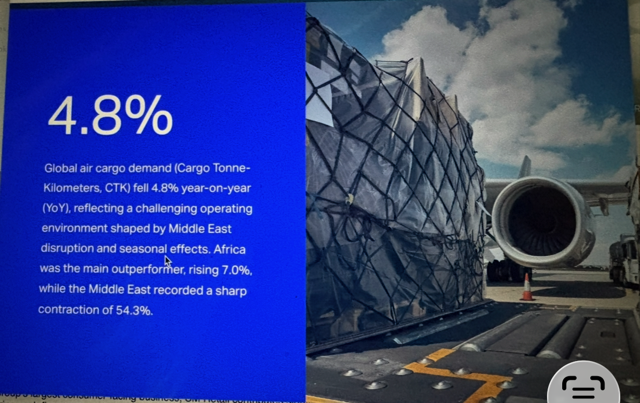
Total air cargo demand slumped by 4.8 percent in March this year while capacity also decreased by 4.7 percent compared to March in 2025 as the Middle East tensions impact global cargo markets, based on the Air Cargo Market Analysis for March 2026 released by the International Air Transport Association (IATA) on Tuesday, April 29.
The contraction in cargo demand reflects a challenging operating environment shaped by Middle East disruption and seasonal effects. Africa was the main outperformer, rising 7.0 percent, while the Middle East recorded a sharp contraction of 54.3 percent.
International cargo traffic declined by 5.5 percent in March, with Africa recording the highest growth. By contrast, Middle East carriers experienced a steep 54.2 percent contraction as hub connectivity and network reliability deteriorated.
Industry capacity also fell 4.7 percent in March versus March 2025, broadly in line with demand. The cargo load factor (CLF) remained stable at 47.9 percent.
Willie Walsh, IATA’s Director General, attributed the decline in demand in cargo markets to the severe disruptions at major Gulf hubs due to war in the Middle East. Walsh said that the timing of the usual post–Lunar New Year slowdown also added to the decline.
“The underlying demand trends, at this point, appear strong and the recent World Trade Organization and International Monetary Fund revisions to trade and GDP projections continue to see growth in 2026. Importantly, air cargo networks are providing the flexibility needed to support global supply chains as they adjust to geopolitical, tariff, and operational strains. All eyes are on fuel supply and price, which are expected to test the industry’s resilience in the coming months,” said.Walsh.
With that, Walsh cited of several factors in the operating environment in the cargo markets. For instance, he pointed to the global industrial production that grew by 3.1 percent year-on-year in February, marking the 38th consecutive month of expansion.
In addition, the global goods trade rose by 8.0 percent year-on-year in February. Jet fuel prices rose sharply in March, up 106.6 percent year-on-year, alongside a 43.1 percet increase in crude oil prices and a 320 percent surge in refining margins.
Notably, global manufacturing sentiment remained in growth territory in March, easing slightly from February. The Purchasing Managers’ Index (PMI) stood at 51.4. The PMI for new export orders was 50.1—both above the 50-point expansion threshold—signaling positive conditions for air cargo demand.

