


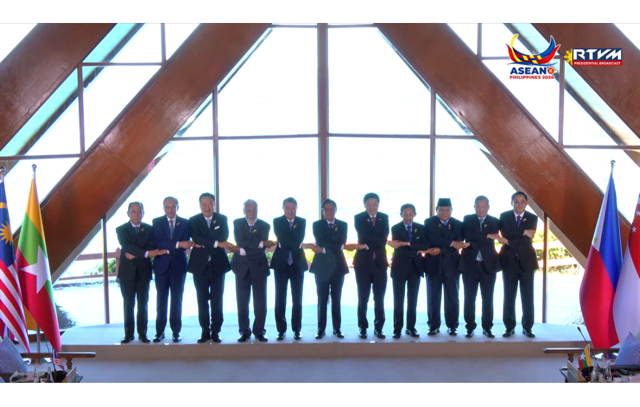
The Association of Southeast Asian Nations (ASEAN) reaffirmed its shared commitment to maintaining and promoting peace, security, stability, and prosperity in the region through full respect for legal and diplomatic processes, without resorting to the threat or use of force, in accordance with international law and the 1982 United Nations Convention on the Law of the Sea (UNCLOS).
Meeting in Manila for the ASEAN Summit, ASEAN leaders issued “A Declaration on Maritime Cooperation” where they also agreed to establish the ASEAN Maritime Centre in the Philippines, which will support ASEAN and ASEAN-led mechanisms on maritime-related issues and promote cross-sectoral and cross-pillar collaboration among member states.
The declaration made several references to the 1982 UNCLOS, with leaders emphasizing its universal and unified character. They reaffirmed that UNCLOS provides the legal framework governing all activities in the oceans and seas and remains strategically important as the basis for national, regional, and global action and cooperation in the marine and maritime sectors. They also stressed the need to preserve the convention’s integrity.
ASEAN leaders said they would work toward concluding negotiations on an effective and substantive Code of Conduct in the South China Sea (COC), in accordance with international law, including the 1982 UNCLOS.
ASEAN leaders noted that all member states are now parties to the 1982 UNCLOS, reflecting the region’s shared commitment to upholding international law and strengthening maritime cooperation to promote peace, security, and prosperity.
The leaders also underscored the importance of maintaining peace, stability, and security in the maritime domain, while ensuring freedom of navigation and overflight, as well as unimpeded lawful commerce, in accordance with international law, particularly UNCLOS.
The declaration further highlighted the importance of stable and reliable global energy supply chains and maritime trade routes, as well as the need to minimize disruptions to the flow of energy, food, and other essential goods. Leaders also stressed the importance of strengthening logistics, energy connectivity, and supply chain resilience.
In addition, ASEAN leaders recognized the need to enhance regional connectivity by strengthening resilient underwater infrastructure, including submarine cables and pipelines, amid evolving maritime challenges.
The declaration also expanded cooperation in areas such as defense and maritime law enforcement; maritime security and safety of navigation; maritime transport connectivity; port development and sustainable shipping; maritime search and rescue (SAR); marine environmental protection (MEP); combating Illegal, Unreported and Unregulated Fishing (IUUF); addressing marine pollution, marine litter, and plastic pollution; protecting critical underwater infrastructure (CUI); promoting the blue economy, ocean science, and ocean governance; and advancing marine scientific research, technology transfer, capacity-building, training, joint exercises, maritime domain awareness (MDA), information-sharing, and exchanges of best practices, consistent with international law and UNCLOS.
ASEAN also aims to advance the work of the ASEAN Coast Guard Forum (ACF) as a platform for cooperation among maritime law enforcement agencies. The forum is expected to strengthen regional capacity and coordination and help develop effective responses to maritime security threats, transnational crimes, and other cross-border maritime challenges in coordination with existing mechanisms.

