


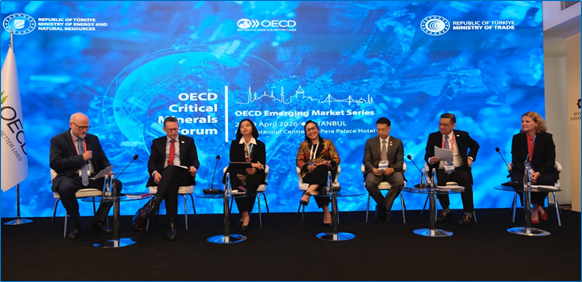
Istanbul, Türkiye—With leading production facilities, significant mineral endowments, and rising foreign investment flows, Southeast Asia is strengthening its position as a pivotal region for critical minerals. This session explored the varying regional perspectives across Southeast Asia, showing how policymakers and industry leaders are adapting to changing market dynamics to attract high-quality investment while mitigating fiscal, environmental, and social risks. Thematic questions included the following: What institutional capacity needs to be developed to attract a diversified base of foreign investment in downstream industries? How can traceability and responsible business conduct be strengthened without slowing down permitting? Are regional tools, such as the ASEAN Minerals Exploration Strategy, sufficient to strengthen regional cooperation while meeting the competing needs of member countries? Tough questions ably addressed by expert panelists from the region.
The Philippines shared the panel with some of its neighbors in Southeast Asia and Australia, including Director-General Aditad Vasinonta, Department of Primary Industries and Mines, Ministry of Industry, Thailand; Director Laksmi Kusumawati, Downstream Planning and International Economic Cooperation, Ministry of National Development Planning/National Development Planning Agency (BAPPENAS), Indonesia; General Secretary Meidy Katrin Lengkey, APNI (Association of Indonesian Nickel Miners), Indonesia; and H.E. Ambassador Stephen Jones, Permanent Representative of Australia to the OECD, as well as Annika Seiler of the Asian Development Bank (ADB).
Pointing out the comparative advantages of the Philippines, not only in terms of natural reserves but also in terms of location and workforce, the question remains: Why aren’t investments coming? What is hindering investments to the Philippines?
Trade Undersecretary and BOI Managing Head Dr. Ceferino S. Rodolfo emphasized that the Philippines has been pursuing critical minerals as a strategic investment priority by increasingly positioning itself as an attractive alternative to existing nickel supply chains and engaging in new agreements with strategic partners. In fact, aside from the “Ps” mentioned earlier—adding people into that mix—the country is actively solving the issues that have riddled the industry. Now, there is greater certainty in terms of policy, anchored in the passage of the “Enhanced Fiscal Regime for Large-Scale Metallic Mining Act,” which provides certainty in terms of sharing, timing, and valuation of minerals. This, plus the move towards a shorter, technology-driven permitting process, from 11 years to 11 months.
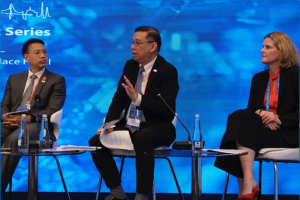
The past 15 years have seen the Philippines implement policies that halted the development of its mining industry—particularly a moratorium on new mineral agreements and a ban on open-pit mining, as well as several local government-level restrictions. However, these challenges have since been resolved, and a clear and stable policy framework on mining development, fully promoting sustainability, is now in place. As a result, however, of the previous years’ ban on key mining activities, “the resources of the Philippines are intact, saved for the present time when we critically need them for energy transition and for AI tech applications.” A call for a fair price and partnership, however, cannot be stressed enough. The government supports international efforts towards these, as we need to ensure that the country and its people get more value added from our minerals.
A gap, however, persists in terms of identifying and developing bankable projects. For this reason, the Philippines and, presumably, much of the resource-rich countries welcome the engagement of the OECD and the Asian Development Bank (ADB) in terms of support for early-stage exploration, project preparation, innovative sharing mechanisms, and surveying of actual minerals that are available, to name a few. These will enable the development of bankable projects across the value chain.
The role of the ADB is critical: The ADB operates at the intersection of development finance, policy reform, and private sector mobilization, which gives it a distinctive vantage point on what makes critical mineral projects bankable and what keeps them from attracting the capital they need. ADB’s approach to critical minerals emphasizes ESG standards alongside investment mobilization through a policy mix of technical assistance, policy advice, and lending. These instruments are complementary, both building off each other and aligning with support being provided by development partners.
Indeed, learning from the experiences and best practices of its neighbors, as well as partnership in the region between countries and regional institutions such as the ADB, can help support investment mobilization into critical mineral value chains, especially for resource-rich countries to develop local value and diversify their economies.

