


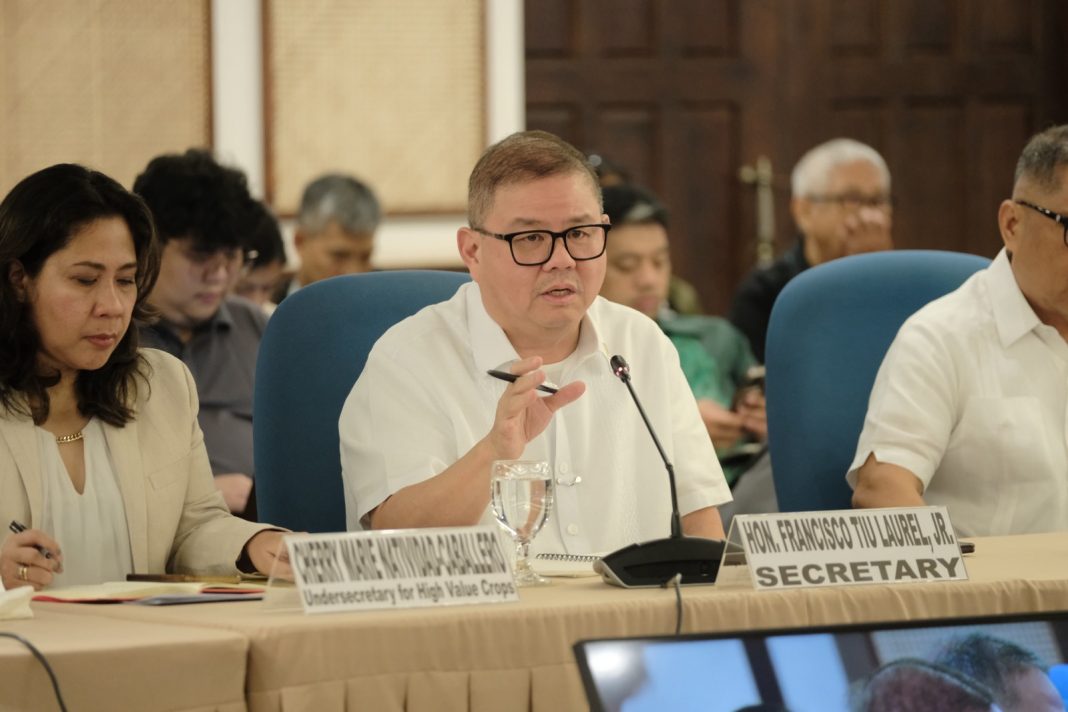
Agriculture Secretary Francisco P. Tiu Laurel Jr. on Wednesday reassured lawmakers that importation remains a last-resort tool, not a standing policy of the Department of Agriculture (DA), stressing that overseas sourcing will only be used in tightly defined cases where supply shortfalls threaten price stability and food security.
“Importation is not our first resort—it is our last line of defense,” Tiu Laurel said in a statement. “Under this administration, we have deliberately reduced dependence on imports. Every decision to allow entry is weighed against its impact on farmers, consumers, and long-term food security.”
During a hearing of the House of Representatives’ Committee on North Luzon Growth Quadrangle ( May 13), Tiu Laurel also laid out a broader preparedness plan to shield the agriculture sector from multiple external shocks, including oil price volatility and the looming risk of a severe El Niño later this year.
North Luzon—covering Regions 1, 2, and the Cordillera Administrative Region—was cited as a critical production hub with more than 2 million hectares of farmland vital to national supply.
As part of the El Niño preparedness strategy, the DA is rolling out climate-resilient interventions aimed at reducing production losses during prolonged dry spells. These include the expansion of greenhouse farming, construction of water impounding and storage systems, and wider deployment of drip irrigation and solar-powered irrigation systems.
The department is also promoting crop diversification to reduce dependence on water-intensive staples and improve farmers’ income resilience.
Tiu Laurel said these measures are intended to shift Philippine agriculture from a reactive to a proactive stance against climate shocks, noting that water stress remains one of the most persistent risks to food security.
A key policy intervention discussed during the hearing was the adjustment of National Food Authority (NFA) palay procurement prices to strengthen farmgate support.
The buying price for freshly harvested palay will be raised to P22 per kilo from the minimum P17, while dry palay buying price will be increased to P27 per kilo from P21 starting September, subject to higher fertilizer costs. “The NFA has the funds and warehouse capacity to sustain better farmgate prices by September,” he said.
The DA chief underscored a broader strategy centered on boosting domestic production, improving logistics, and tightening coordination with local governments and industry stakeholders to reduce reliance on emergency importation. He said stronger forecasting systems are also being developed to better anticipate supply gaps before they escalate.
Lawmakers raised concerns over potential food price pressures, prompting Tiu Laurel to reiterate that imports will remain data-driven, time-bound, and strictly necessity-based. To strengthen effective production planning and access to accudate and timely information, data harmonization is also ongoing between the Philippine Statistics Authority (PSA) and DA.
“We will not normalize imports,” he said in a statement. “They will only be deployed when supply truly fails, prices spiral, and consumers are at risk. Our priority is simple: strengthen local agriculture first, and import only when absolutely unavoidable.”

