


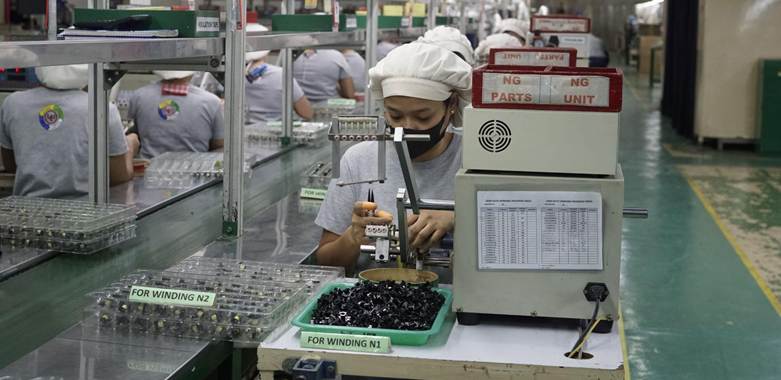
The Philippines’ export sales extended their upward trajectory, reaching USD7.21 billion in April 2026, up by 6.3 percent from April 2025, based on preliminary data from the Philippine Statistics Authority (PSA). This latest performance marks the country’s 16th consecutive month of sustained export growth, highlighting sustained momentum amid evolving global trade conditions.
From January to April 2026, total exports reached USD29.93 billion, up from USD 26.93 billion during the same period last year, marking the highest export earnings recorded for the first four months of the year in over four years.
|
Month
|
Export Value (USD Billion)
|
Growth vs. Same Month in 2025
|
|
January
|
7.09
|
8.7%
|
|
February
|
7.33
|
8.9%
|
|
March
|
8.17
|
20.8%
|
|
April
|
7.21
|
6.3%
|
DTI Secretary Cristina A. Roque said the country’s export performance puts a spotlight on the government’s continued efforts to strengthen the competitiveness and readiness of exporters amid changing global market conditions.
“As international trade environment continues to evolve, it is important that our exporters are prepared to adapt to new requirements and challenges. We continue to collaborate closely with industry partners, the private sector, and international organizations to help Philippine exporters become more competitive, market-ready, and globally connected,” Secretary Roque said.
Increased export sales in April were driven primarily by higher export sales of electronics, minerals and agro-based products.
Electronic products remained the country’s top export in April 2026, generating USD3.44 billion or 47.7 percent of total exports during the period. This is supported by strong demand for consumer electronics, telecommunication and office equipment used in emerging technologies such as artificial intelligence (AI) and Internet of Things (IoT), highlighting the Philippines’ continued participation in global electronics value chains.
Other key contributors included other mineral products at USD 458.95 million, and machinery and transport equipment at USD 423.36 million. Among commodity groups, machinery and transport equipment recorded the highest annual increase in export value followed by coconut oil and other mineral products, pointing to broad-based gains across industries.
Exports of coconut-based products also continued to benefit from global demand for food ingredients and plant-based alternatives, further strengthening the country’s agro-based export segment.
In terms of markets, the United States remained the country’s top export destination in April 2026, accounting for USD1.30 billion or 18.0 percent of total exports. This was followed by China with USD926.66 million, Japan with USD914.64 million, Hong Kong with USD914.59 million, and Singapore with USD 332.75 million.
To sustain this export momentum, the DTI, through the Export Marketing Bureau (DTI-EMB) continues to implement initiatives to strengthen exporter readiness. These include capacity building initiatives on sustainability and traceability workshops in partnership with the International Trade Centre (ITC) and the European Union (EU) under the Climate Competitiveness Project, women-focused export readiness workshops, and MSME-oriented trainings on logistics, customs, and digital trade under the Regional Trade for Development (RT4D) initiative and DHL GoTrade.
The Department is also stepping up efforts to support MSMEs in accessing new markets through Halal certification assistance, as well as trade fairs, business matching activities, and business missions, leveraging on its network of Philippine Trade and Investment Centers (PTICs) worldwide.
Despite the positive April results, the DTI noted that external risks remain, including geopolitical tensions such as the ongoing Middle East crisis that continues to put pressure on oil supply, and foreign exchange volatility, which can have mixed effects on exporters depending on their reliance on imported inputs.
The DTI continues to monitor global developments that may affect trade and supply chains, and work closely with industry stakeholders to strengthen market diversification efforts and support exporters in navigating global uncertainties.

