


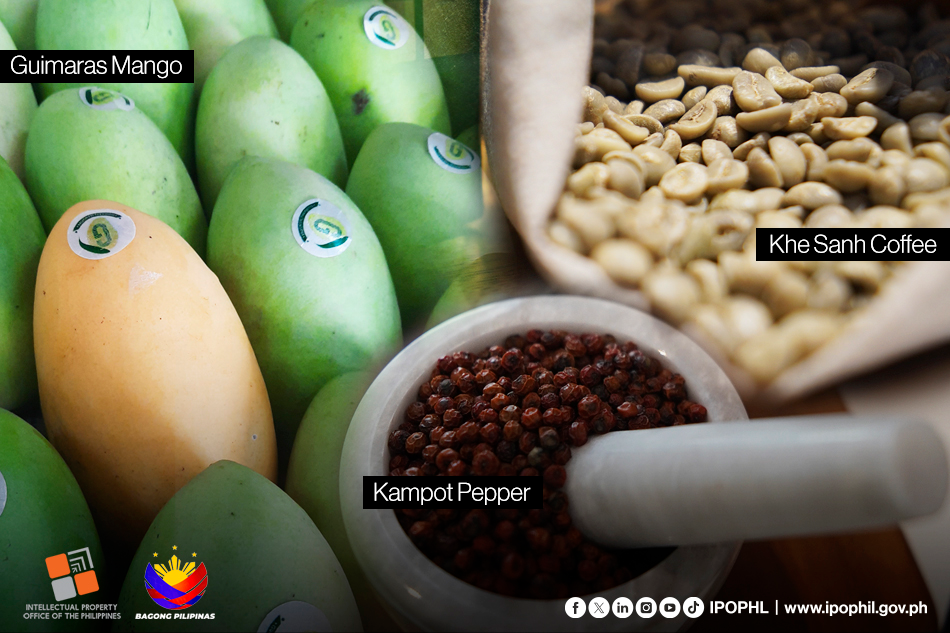
Thi Diem Nhi Do described mornings in her hometown in the Quang Tri province where mist and fog blanket the mountains before giving way to afternoon sunlight. A representative of Khe Sanh Coffee producer and trader Nam Hai CNS, she said this dramatic shift in temperature and climate helps create a distinct coffee flavor known for its balanced bitterness and rich aroma.
In Laos, while sticky rice is common, Somxai Chanthalungsy stressed the uniqueness of Khao Kai Noi sticky rice grown in the country’s cooler northern highlands. “People think sticky rice is sticky rice,” he said, representing the Khao Kai Noi Houaphanh Promotion Association, “But the aroma, the quality, the uniqueness are totally different.”
As a child, producer Sothi Sorn recalled being warned by her grandparents never to plant Kampot pepper, a product with a prestige that stretches generations back yet whose future is threatened by labor-intensive traditional methods that makes it difficult to attract younger generations.
“A single plant requires 30 liters. And if you have 30, 50 plants, imagine how [much water you need to] carry by your own shoulder,” said Sorn, a member of the Kampot Pepper Promotion Association.
Today, Kampot pepper has become one of Southeast Asia’s most recognized GI products, supported by an association that has grown more than tenfold since its establishment in 2008.
Some of the most iconic GI products were showcased at the exhibit of the ASEAN Regional Geographical Indications (GI) Forum, organized by the Intellectual Property Office of the Philippines (IPOPHL) in partnership with the European Union Intellectual Property Office (EUIPO) through its SCOPE IPR (Support to Cooperation on Intellectual Property Rights) Project, in Iloilo City.
These products, protected as geographical indications (GIs), have become symbols of identity and economic opportunity. Around the world, more than 20,000 GIs, from Champagne to Café de Colombia, demonstrate how origin-linked goods can command premium value as consumers increasingly seek authenticity.
In recent years, ASEAN member countries have been expanding their own GI baskets. But behind the branding campaigns and export ambitions lies the challenge of proving authenticity consistently enough for consumers to trust the label. The task requires transforming centuries-old traditions into enforceable systems.
The journey of ASEAN member countries in GI protection shaped conversations at the 2026 ASEAN Regional Geographical Indications Forum and Exhibition in the Philippines held in May 2026 with the theme “SynerGI: Building Alliances for Sustainable GI Development.” Producers, policymakers and international experts gathered to discuss the deeper question of what exactly ASEAN is trying to protect and what it takes to do it well. Experiences revealed that a collective responsibility across government, business partners and even consumers must be forged and sustained to keep GI products alive.
Enforcement challenges
Securing a local registration is only the first step of a much longer battle. The moment a unique local product finds commercial success, it inevitably catches the attention of counterfeiters looking to cash in on its hard-earned reputation.
Speaking virtually at the forum, Massimo Vittori, Managing Director of oriGIn, highlighted this vulnerability. “The more you have success, the more you have infringements… So [enforcement] is a priority for producers all over the world,” he said.
This risk is already a reality. In the Philippines, Guimaras Mango Growers and Producers Development Cooperative (GMGPDC) Vice-Chair Elena Quezon said the popularity of the Guimaras Mango has led to widespread unauthorized labelling of ordinary mangoes as “Guimaras mangoes” despite having no connection to the province.
The rise of e-commerce has expanded opportunities but also opened doors to fakes. Khairul Anuar Amad Zaini, Intellectual Property Officer of the Intellectual Property Corporation of Malaysia, recalled a court case involving fake Tenom Coffee sold online.
To combat misuse, producers are increasingly adopting traceability tools such as QR codes, online verification systems and controlled distribution channels. In Guimaras, the local cooperative partnered with the Department of Trade and Industry to launch an agreement with verified logistics forwarders to handle the delivery of the mangoes exclusively.
Cooperation across the value chain
GMGPDC’s Quezon described how strict local ordinances and quarantine controls prevent mangoes from other provinces from entering the Guimaras Island in order to preserve the integrity of its mangoes. Fruits harvested too early could also be confiscated and barred from entering the market.
Farmers themselves help enforce the rules by reporting violators to authorities. “They were the police among themselves,” she explained.
In Cambodia, Kampot Pepper’s success was described as the product of cooperation among farmers, business partners, associations and government agencies working together to maintain standards and expand global recognition.
Vietnam stressed that GI systems only work when farmers and exporters share a “common vision” and common standards for quality. Without alignment, product reputation can easily weaken in export markets.
Everyone as partners for collective trust
Beyond the value chain, partners like government can enable policies and provide support to start and sustain a community’s GI journey.
Bureau of Trademarks Director Jesus Antonio Z. Ros shared that the Philippines’ journey toward developing a sui generis GI system began in 2004 when IPOPHL started engaging local producers, going from village to village to introduce GI. After more than two decades with partner agencies, IPOPHL has identified over 30 potential GIs in the country from only eight in 2011, all while simultaneously helping communities learn about the technical aspects of the process, including the manual of specifications that is crucial in application as it explains the link between a place and a product.
Hendar Kristanto, Directorate General of Intellectual Property Indonesia, explained that preparing such extensive GI documentation in some communities proved challenging as many producers lacked technical writing skills or familiarity with legal processes. “One document took eight years,” he shared.
Vittori of origin noted that GI protection internationally is increasingly becoming a collaborative effort involving governments, producer associations, legal experts, technology firms and enforcement bodies working together to exchange expertise and best practices.
Consumers themselves can make a vote for authenticity by keeping informed about legitimate distribution channels, developing discernment between authentic and counterfeits and reporting these to producers. “If in Manila, when they say it’s Guimaras Mangoes, we can ask, ‘When was it harvested?’ ‘Which town did you harvest that?’ If they cannot answer, please don’t buy that. It doesn’t come from Guimaras,” Quezon said.
The forum’s emphasis on synergy revealed what ASEAN is truly trying to protect. The answer extends far beyond markets to places of pride, identity and memory, whether of wide climate swings in the mountains or an arduous trek of carrying water by the shoulders and to the fields. The stories differ in product, geography and language but the shared promise of GI is the link between a product and its place of origin. In a digital age and complex global supply chains, everyone can play a role in preserving that promise.

