


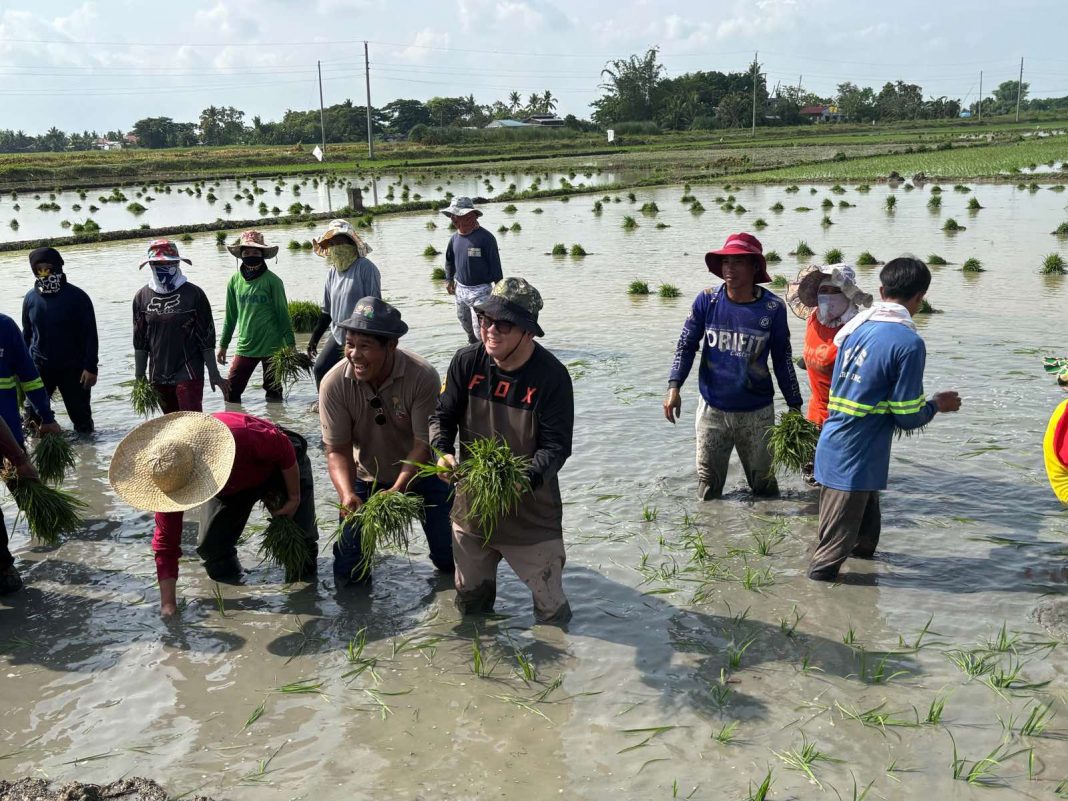
STA. ROSA, Nueva Ecija — Less than 24 hours after accompanying President Ferdinand Marcos Jr. on a state visit to Japan, Agriculture Secretary Francisco P. Tiu Laurel Jr. found himself in a very different arena on Saturday, ( May 30, 2026).
Gone were the suits and ties, diplomatic courtesies, and polished conference halls. In their place were flooded rice paddies, leg-deep mud, and neat rows of seedlings waiting to be planted under the relentless Nueva Ecija sun.
For a couple of hours, the agriculture chief traded policy papers for palay seedlings as he joined local farmers in the annual ritual that marks the beginning of another cropping season in the country’s rice capital.
The mud, however, was an unforgiving teacher.
Each step sank into the soft earth. Balance became a daily puzzle that farmers solve almost instinctively. Planting row after row required patience, rhythm, and stamina, qualities often discussed in government meetings but best understood with mud between one’s toes.
“It is important for me to see and experience first-hand what they do, especially here in Nueva Ecija, the main rice-producing province of the country, where farm yields are high,” Tiu Laurel said.
For those who know the secretary, the field immersion was hardly out of character.
Long before he headed the Department of Agriculture, Tiu Laurel developed a reputation for learning industries from the ground up. When he entered the fishing business decades ago at the prodding of his father, he spent time aboard fishing vessels, observing operations firsthand and learning the trade from fishermen, captains, and workers rather than solely from reports and balance sheets. “The sea was my university,” he once described his life education.
That hands-on approach has become second nature. This time, the classroom happened to be a rice field.
“I want to feel the hardship and exhaustion that our farmers go through. I will wade through the mud, find my way, and probably slip, get wet, and get covered in mud. That’s okay. What’s important is that I learn and experience, even briefly, the hardships and perseverance of our farmers,” he said.
The scene was a reminder that behind every sack of rice are workers who battle heat, mud, unpredictable weather, pests, and rising production costs long before a single grain reaches the market.
Beyond the ceremonial planting, Tiu Laurel spent time listening to farmers’ concerns. Requests ranged from farm-to-market roads and post-harvest facilities to farm machinery, solar-powered irrigation systems, deep wells, submersible pumps, and adjustments to certain regulations affecting agricultural production.
The discussions also turned toward new opportunities.
Fresh from Japan, Tiu Laurel shared technologies that could help farmers diversify income sources. Among them were techniques for producing rice wine or sake and innovative storage systems that could allow dehusked rice to be preserved for years instead of months.
He also encouraged farmers to look beyond traditional crops. Starting in the second half of the year, the Department of Agriculture plans to support expanded production of high-value crops such as bell peppers, tomatoes, ube, and other specialty products that offer stronger margins and growing market demand.
For Tiu Laurel, boosting farm incomes increasingly means helping farmers produce not just more, but better and more profitable crops.
As he emerged from the paddy, feet and pants coated in mud and his clothes marked by the morning’s work, the secretary carried home more than a few stains.
He left with a deeper appreciation of the labor, patience, and resilience that sustain the nation’s food supply and a renewed conviction that understanding agriculture begins not in an office, but in the field itself.

