


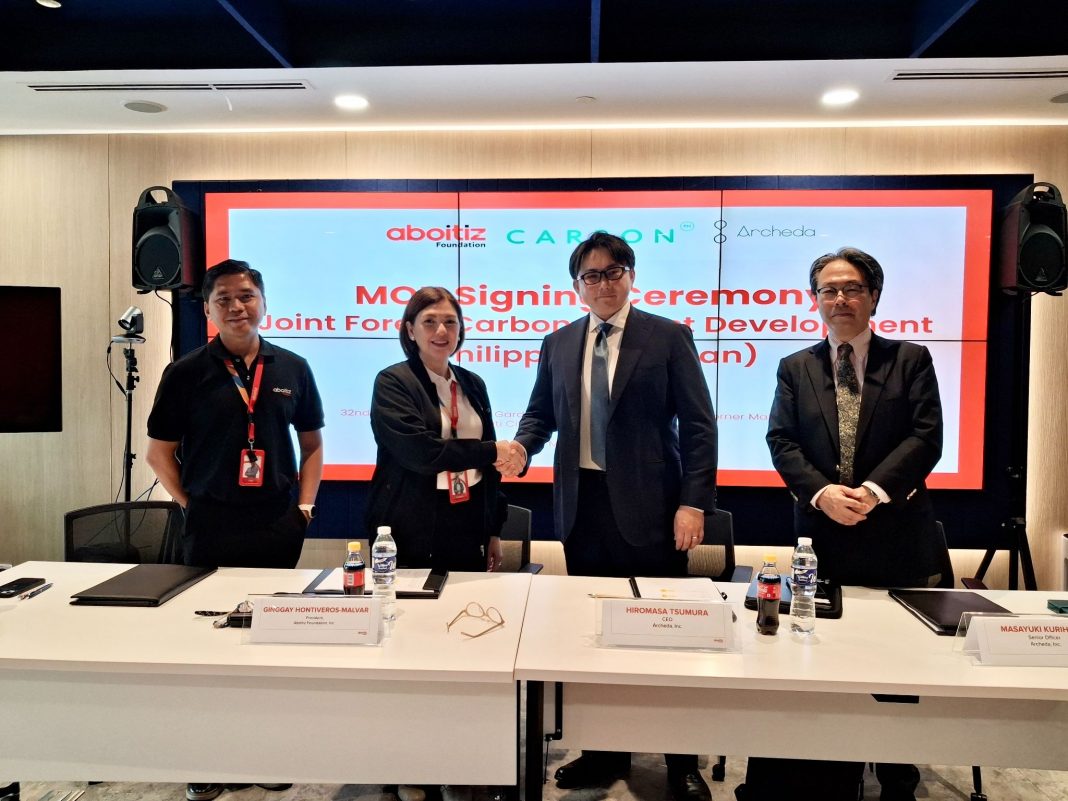
Aboitiz Foundation and Archeda Inc., a Japan-based climate technology company specializing in satellite-powered environmental monitoring and carbon project development, have signed a Memorandum of Understanding (MOU) to jointly explore and develop high-integrity forest carbon projects in the Philippines under CarbonPH. The partnership aims to help unlock the country’s natural capital while advancing climate resilience, environmental protection, and sustainable development.
The collaboration brings together Aboitiz Foundation’s commitment to sustainable and inclusive development and Archeda’s expertise in satellite technology, artificial intelligence, monitoring, reporting, and verification (MRV) systems, and carbon project structuring. Through the partnership, both organizations will assess opportunities to develop forest carbon projects under internationally recognized frameworks, initially prioritizing the Japan-Philippines Joint Crediting Mechanism (JCM), which supports climate action aligned with Article 6 of the Paris Agreement.
The Philippines is home to some of the world’s most important forest ecosystems and biodiversity resources, yet remains underrepresented in global carbon markets. As climate risks intensify and demand grows for credible climate solutions, the partnership seeks to help position the country as a meaningful participant in emerging low-carbon economies through projects grounded in scientific rigor, transparency, and measurable impact.
“The partnership with Archeda reflects a shared commitment to help shape the future of climate action in the Philippines through credible, high-integrity forest carbon development,” said Ginggay Hontiveros-Malvar, President of Aboitiz Foundation.
“Protecting forests is not only about addressing climate change. It is also about safeguarding watersheds, strengthening water security, supporting local livelihoods, and building resilience for future generations,” she added.
Under the agreement, Aboitiz Foundation and Archeda will collaborate on feasibility studies, satellite-based environmental assessments, carbon project design, stakeholder engagement, and the development of robust monitoring and verification systems. The partnership also seeks to explore innovative financing and commercialization pathways that can help mobilize long-term investment toward forest conservation and restoration.
A key component of the collaboration is the use of satellite technology and advanced data analytics to strengthen project transparency and accountability. By enabling continuous, objective monitoring of forest landscapes, these tools can support stronger environmental stewardship while helping establish the credibility increasingly required in global carbon markets.
“At Archeda, our mission is to unlock the hidden value of the Earth,” said Hiromasa Tsumura, Chief Executive Officer of Archeda. “We believe satellite technology can play an important role in addressing climate challenges by improving transparency, strengthening trust, and enabling better decision-making. Through this partnership, we hope to demonstrate how technology can help create climate solutions that benefit both people and the planet.”
The partnership also seeks to contribute to the evolution of compliance-grade carbon markets by integrating advanced monitoring technologies with practical financing structures. Both organizations see the opportunity to establish a model for high-quality forest carbon development that can serve as a reference not only for the Philippines, but also for other countries pursuing credible climate action pathways.
“We believe the Philippines has the potential to become a leader in high-integrity forest carbon development,” Tsumura added. “By combining innovation, strong governance, and long-term commitment, we hope to create an example that demonstrates how environmental protection and sustainable development can move forward together.”
As the Philippines navigates increasingly complex climate challenges, Aboitiz Foundation and Archeda aim to help build a future where forest conservation, community development, and economic opportunity reinforce one another—creating long-term value for both people and the planet.

