


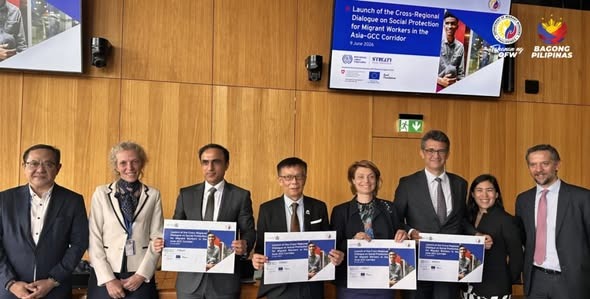
The Philippine government and the Gulf Cooperation Council (GCC) Executive Bureau have officially launched a landmark cross-regional dialogue platform aimed at advancing social protection for millions of migrant workers across the Asia–GCC labor migration corridor.
The high-level launch took place on the sidelines of the 114th International Labour Conference (ILC) in Geneva and marks a significant step toward strengthening cooperation between countries of origin and destination in promoting the welfare and rights of migrant workers.
Supported by the International Labour Organization’s (ILO) Strengthening Social Protection and Human Rights for Migrant Workers (STREAM) Programme, the initiative establishes a regular mechanism for dialogue and collaboration among participating countries. The platform seeks to bridge policy and implementation gaps, foster mutual understanding, enhance cross-border coordination, and promote the portability of social security benefits and rights for migrant workers.
As a recognized global leader in labor migration governance, the Philippines will co-chair the platform alongside the GCC Executive Bureau. This unique arrangement underscores the shared responsibility of both origin and destination countries in ensuring comprehensive protection for migrant workers throughout the migration cycle.
Leading the Philippine delegation, Department of Migrant Workers (DMW) Secretary Hans Leo J. Cacdac emphasized the importance of collective action in addressing the evolving needs of migrant workers.
“While national frameworks provide initial safety nets, a unified, cross-border approach is essential to fully ensure the welfare of Overseas Filipino Workers (OFWs) and other migrant workers,” Secretary Cacdac said.
Valerie Schmitt, Deputy Director of the ILO Social Protection Department, welcomed the joint leadership of the Philippines and the GCC Executive Bureau, highlighting the significance of collaborative governance in advancing migrant workers’ rights.
“Having both sides of the migration corridor—origin and destination countries—actively steer the platform sends a powerful message that effective social protection requires genuine partnership and shared responsibility,” Schmitt noted.
Initially, the platform will focus on structured technical exchanges among participating countries to identify best practices, address common challenges, and develop practical solutions that strengthen social protection systems for migrant workers.
Through sustained dialogue and cooperation, the initiative aims to become a global model for advancing social protection and safeguarding the rights and welfare of migrant workers worldwide.

