


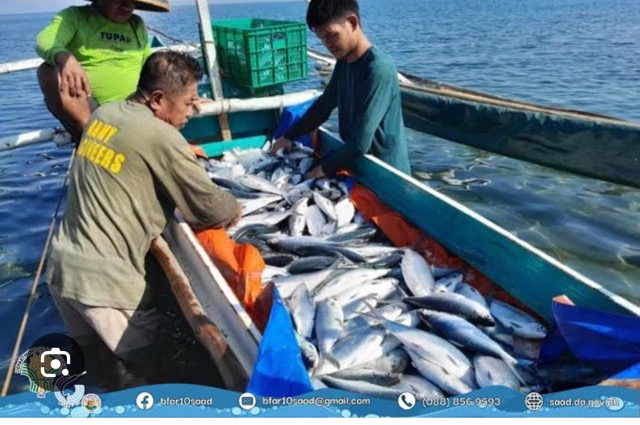
The Department of Agriculture (DA) is betting on this coastal municipality to become a major fisheries and agricultural growth center in Eastern Visayas, backing that vision with more than PHP300 million in assistance, insurance coverage, and production support aimed at raising incomes and accelerating rural development.
Agriculture Secretary Francisco P. Tiu Laurel Jr. led the distribution of interventions and financial assistance to farmers and fisherfolk on Thursday, describing Mapanas and the rest of Northern Samar as strategically important to the government’s long-term food security agenda.
“We are here with a clear purpose: to transform Mapanas into a premier agri-fishery hub in Eastern Visayas,” Tiu Laurel said. “Your rich coastal waters have immense potential as a rising powerhouse for tuna and high-value deep-sea commercial fishing, while your fertile soils are uniquely primed for high-value crop production.”
The DA chief said the province’s extensive marine resources and agricultural land position it to become a key contributor to regional food production and rural economic growth.
To provide immediate relief amid rising living costs, Tiu Laurel also announced the rollout of the government’s “Benteng Bigas, Meron Na!” initiative in the area. The program provides access to those in vulnerable sectors, including registered farmers and fisherfolk, to P20 per kilo rice.
“We know how heavily inflation weighs on family budgets. This is our immediate way of helping ensure that affordable rice remains accessible while allowing farming and fishing households to focus on improving productivity and livelihoods,” he said.
The DA distributed P4.7 million worth of agricultural interventions, including quality seeds, farm inputs, and equipment under various banner programs. Cash assistance was also released to more than 2,000 qualified beneficiaries through the Presidential Assistance to Farmers and Fisherfolk Program.
A major component of the support package was the ceremonial turnover of PHP293 million worth of crop and fishery insurance coverage from the Philippine Crop Insurance Corp. (PCIC), providing protection against typhoons, flooding, and other climate-related risks that frequently affect agricultural communities in Northern Samar.
The department also provided P1.2 million worth of abaca stripping machines to help mechanize fiber processing, improve product quality, and increase earnings for local abaca growers.
Aside from the support for farmers, Secretary Laurel has also committed to help bolster the tuna industry of the municipality.
The investment push comes as Mapanas continues to face significant development challenges despite its resource base.
The municipality has 1,528 registered farmers and 816 fisherfolk, while its fisheries area spans about 16,500 hectares. Yet nearly three out of every 10 residents remain below the poverty line, and average annual household income is estimated at only P63,000.
Mapanas is known for its tuna, coconut, cassava, and abaca production, giving it a diverse economic base. But as in many rural communities, production has not always translated into higher incomes.
The DA’s strategy reflects a broader shift from simply increasing output to building more competitive agricultural value chains.
By combining production support, insurance protection, mechanization, and market-oriented development, the government hopes to unlock the municipality’s potential as a fisheries and agricultural hub while ensuring that more of the value generated by its natural resources stays with local communities.

