


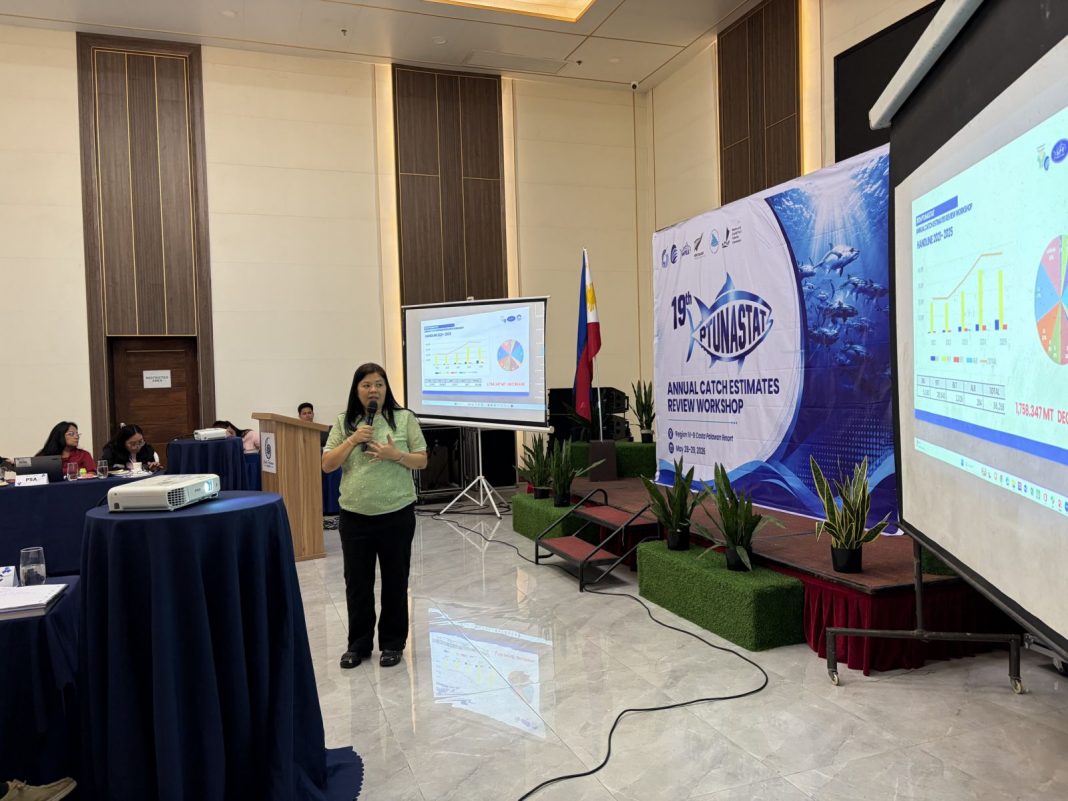
The Philippines has finalized its 2025 annual tuna catch estimate at 230,347 metric tons (MT), providing the official national statistics to be submitted to the Western and Central Pacific Fisheries Commission (WCPFC) and supporting regional tuna stock assessments and fisheries management efforts.
The estimate was finalized during the 18th PTUNASTAT Annual Catch Estimates Review Workshop conducted by the Department of Agriculture–National Fisheries Research and Development Institute (DA-NFRDI) through the Western Pacific East Asia–Sustainable Pacific Fisheries (WPEA-SPF) Project on May 28-29, 2026, in Puerto Princesa City, Palawan.
The workshop was led by WPEA-SPF Project Leader Suzette Barcoma, with the participation of Capture Fisheries Research and Development Division (CFRDD) Chief Elsa Furio, Assistant Chief Eunice Bognot, and National Stock Assessment Program (NSAP) Coordinator Francisco S.B. Torres Jr.
National and international fisheries experts also joined the review, including Dr. Tiffany Vidal of the Pacific Community (SPC), Lars Olsen of the Western and Central Pacific Fisheries Commission (WCPFC), and WCPFC Assistant Science Manager Elaine Garvilles, who participated virtually.
The activity consolidated, reviewed, and validated oceanic tuna catch estimates generated during the 17th WPEA-NSAP Tuna Catch Data Review Workshop and reconciled these with fisheries data from the Bureau of Fisheries and Aquatic Resources (BFAR), Ministry of Agriculture, Fisheries and Agrarian Reform (MAFAR), Philippine Statistics Authority (PSA), Philippine Fisheries Development Authority (PFDA) offices in General Santos City, Davao, Iloilo, and Navotas City, as well as the SOCSKSARGEN Federation of Fishing and Allied Industries, Inc. (SFFAII).
Through the comparison and validation of various datasets and estimation methods, participants finalized the country’s annual tuna catch estimates, which are reported by species and fishing gear in accordance with WCPFC reporting requirements.
Skipjack tuna remained the dominant species, accounting for more than 58 percent of the total estimated catch. Yellowfin tuna contributed approximately 39 percent, followed by bigeye tuna at about 3 percent and albacore tuna at less than 1 percent.
Among fishing gears, purse seine fisheries accounted for more than 46 percent of the total estimated tuna production, maintaining their position as the largest contributor to the country’s tuna catch. Region 12 also recorded the highest volume of tuna landings nationwide.
To further improve the quality and reliability of tuna fisheries statistics, participants recommended strengthening catch reporting by species, fishing gear, and fishing grounds; enhancing data coverage and alignment with WCPFC standards; standardizing gear classifications; incorporating distant-water catches into electronic reporting systems; and improving data sharing among partner agencies.
The next PTUNASTAT Annual Catch Estimates Review Workshop is scheduled for April 2027.
The workshop reaffirmed the commitment of NFRDI, BFAR, MAFAR, PSA, PFDA, SFFAII, SPC, and WCPFC to strengthening fisheries data systems, advancing science-based fisheries management, and supporting the sustainable development of Philippine tuna fisheries.

