


Office space vacancy rates in Metro Manila are expected to remain in the 18 percent range for the rest of 2026 amid soft market demand and the continued influx of new office supply, according to leading real estate consultancy JLL Philippines.
Janlo de los Reyes, head of research and advisory at JLL Philippines, presented a generally subdued outlook for the Metro Manila office market during the firm’s Metro Manila Real Estate Market Overview briefing, citing external factors, particularly the continuing conflict involving Iran, as among the headwinds affecting business sentiment.
JLL data showed that the Metro Manila office vacancy rate improved to 18.2 percent in the second quarter of 2026 from 18.5 percent in the first quarter, supported by resilient tenant activity.
However, De los Reyes said that while vacancy is expected to improve further in the second half of the year, the continued delivery of new office space will temper those gains.
“Vacancy rate is going to elevate again,” he said, adding the vacancy rate will remain within the 18 percent range for the remainder of 2026.
During the second quarter, new office supply slowed to 47,500 square meters (sqm), roughly half of the 96,700 sqm recorded in the first quarter.
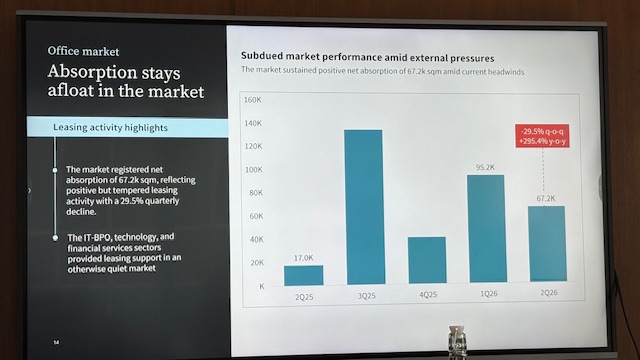
Net absorption also eased to 67,200 sqm in the second quarter from 95,200 sqm in the previous quarter, reflecting a 29.5 percent decline in leasing activity.
“The IT-BPO, technology, and financial services sectors provided leasing support in an otherwise quiet market,” said De los Reyes.
Joey Radovan, JLL Philippines country head, noted that while Metro Manila’s overall weighted average vacancy rate appears elevated, occupiers pay closer attention to vacancy levels within individual central business districts (CBDs) when deciding where to locate.
He explained that vacancy rates may appear higher in certain districts because of their relatively smaller office inventory.
Vacancy rates in CBDs
JLL noted that CBDs with larger office inventories generally posted lower vacancy rates than districts with smaller office stock.
For instance, the Makati CBD posted a vacancy rate of 17 percent despite having a total office inventory of 388,000 sqm. Similarly, Bonifacio Global City (BGC) in Taguig recorded an 11 percent vacancy rate with a total office inventory of 335,000 sqm.
In contrast, CBDs with vacancy rates ranging from 19 percent to 40 percent generally have much smaller office inventories. Manila posted a vacancy rate of 40 percent but has only 25,000 sqm of office space.
Parañaque recorded a vacancy rate of 45 percent with a total office inventory of 157,000 sqm. Pasay posted a vacancy rate of 28 percent, while Quezon City, Muntinlupa, and Pasig each recorded a 19 percent vacancy rate.
De los Reyes attributed the softer market conditions to weaker leasing activity during the second quarter, as many tenants deferred expansion and relocation decisions. As a result, leasing transactions fell 50.4 percent to 145,000 sqm, although stronger tenant retention helped cushion the decline in net absorption.
Demand also increasingly shifted toward flexible office space rather than traditional long-term leases, as occupiers prioritized flexibility amid uncertain market conditions. JLL expects this trend to reverse as market conditions stabilize.
The Makati CBD led leasing activity during the second quarter with 38,000 sqm of transactions, driven by the fast-moving consumer goods (FMCG) and technology sectors. Move-outs also declined sharply to just 10,000 sqm, a 56 percent drop from the first quarter. De los Reyes said this reflects strong tenant confidence and retention in the country’s premier business district.
Taguig recorded 37,000 sqm of leasing activity, supported mainly by the construction and technology sectors, although move-outs remained relatively elevated because of the district’s more dynamic tenant base.
By industry, global capability centers (GCCs) and business process outsourcing (BPO) firms remained the largest office occupiers, followed by companies in technology, media and entertainment, construction, and financial services.
Average office rental rates were largely unchanged during the second quarter, posting a modest 3.1 percent year-on-year increase to P1,006 per sqm from P997 per sqm.
Supply pipeline

Total Metro Manila office stock reached 11.6 million sqm in the second quarter of 2026, including 144,000 sqm of newly completed Grade A office space delivered during the period.
From the second quarter of 2026 through 2030, JLL estimates that approximately 1.5 million sqm of additional office space will be completed across 35 new projects, seven of which will be located in the Makati and BGC central business districts.
Makati, Mandaluyong, Quezon City, and Taguig BGC topped the list with the most number of new office space supply over the next four years.

