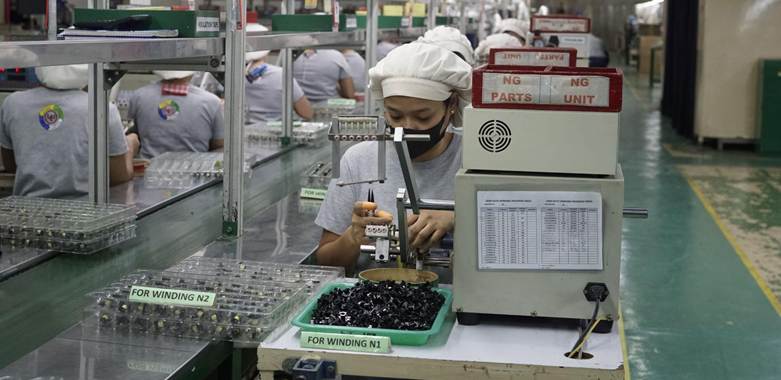
The Philippine electronics and semiconductor industry expects exports to grow by 10 percent this year, reaching between USD 53 billion and USD 54 billion. This is an increase from USD 49.6 billion in 2025, primarily driven by surging demand for artificial intelligence (AI) and data server infrastructure.
Dan H. Lachica, president and CEO of the Semiconductor and Electronics Industries in the Philippines Foundation Inc. (SEIPI), noted that while it is difficult to break down how much growth stems directly from AI—given its integration across multiple sectors—he said, ”It is safe to say that 10 percent growth.”
In fact, Lachica mentioned that the industry’s 16 percent growth in 2025 was unexpected. Initial forecasts predicted flat performance due to global headwinds, including U.S. tariffs and geopolitical conflicts, but demand for AI ultimately accelerated growth.
Lachica explained that although the domestic industry does not manufacture AI chips directly, local firms produce critical support equipment. These include components for networking, switching infrastructure, and power control, all of which are essential for running data centers and AI engines.
As of 2025, semiconductors remain the backbone of the country’s electronics exports, accounting for 70 to 75 percent of the total, despite representing only a 5 percent share of the global semiconductor market.
Meanwhile, Electronics Manufacturing Services (EMS) accounts for roughly 27 percent of the domestic industry mix. However, the Philippines holds just a 1 percent share of the global EMS market, which primarily covers consumer goods like smartphones and electronic devices embedded with AI applications.
To expand its global footprint, SEIPI’s industry roadmap focuses on scaling up the EMS sector. Local EMS providers are currently transitioning from basic component assemblers into complete system integrators for data-heavy AI infrastructure.
“It’s gonna be instrumental in growing our EMS share to the global market … because it’s a very big trillion dollar market where our share is just one percent for now,” said Lachica.
Hong Kong serves as the primary transshipment port and largest market for Philippine electronics, followed closely by the United States and China.
Photo credit: (https://seipi.org.ph/)
Imports and supply chain expansion
Electronics are the Philippines largest export, making up over 50-60 percent of the country’s total export revenue. But it has also a huge import component.
Thus, the need to establish the missing link in the industry’s processes.
Lachica said that the domestic industry is expanding into semiconductor packaging, starting with Integrated Circuit (IC) design. It has also a strong test and assembly operation.
However, but it needs to establish a wafer fabrication facility as this remains vital to creating a fully integrated, end-to-end semiconductor supply chain.
To demonstrate this capability, SEIPI is partnering with the Department of Science and Technology (DOST) to develop a blueprint. They plan to submit this proposal by 2027 to present a proof of concept for a commercial-scale wafer facility.
“They don’t realize our full potential. Okay, we have to show the proof of concept,” he said.
Currently, raw wafers make up the bulk of the country’s electronics imports. Wafer fabrication is the core front-end operation in semiconductor processing, where microscopic integrated circuits are built layer by layer on pure silicon discs. This highly complex phase establishes the electrical characteristics and functions of the microchips before they undergo back-end assembly and testing.