


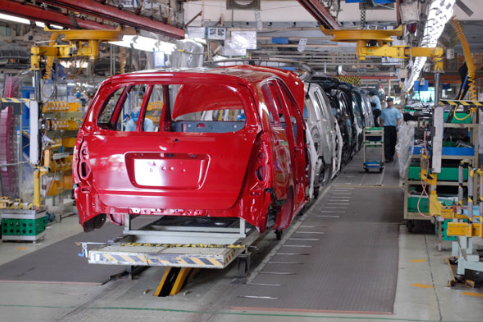
Automotive research firm Mobility Global’s latest monthly forecast identified the Philippines as Southeast Asia’s weakest-performing vehicle production market for the second month in a row. This comes despite positive updates for the broader region and the global auto industry as a whole.
In its August 2026 light vehicle production forecast, published August 18, Mobility Global said ASEAN performance is “increasingly split.” Thailand improved, while Indonesia, Malaysia, and Vietnam were softer in July. The Philippines, the report said, “remains the weakest” among the bloc’s major auto-producing economies.
Despite the Philippines’ lagging standing, Mobility Global still raised its outlook for the wider South Asia region (which includes ASEAN and India) by 104,000 units for 2026 and 40,000 units for 2027, trimming 27,000 units from the 2028 forecast. ASEAN alone accounted for a 60,000-unit lift to the 2026 forecast, which the firm attributed to year-to-date trends and stronger original equipment manufacturer (OEM) production schedules across the region, not to any specific improvement in the Philippine market. The report did not disclose a Philippines-specific production volume or growth figure. India was the region’s standout, with its forecast raised by 41,000 units for both 2026 and 2027, driven by a Goods and Services Tax cut and lean dealer inventories. Mobility Global is a spin-off publicly traded company of financial data analytics provider S&P Global.
A month earlier, Mobility Global’s report from July 22 indicated that production across ASEAN had declined by 9.5% year-on-year in June. A slowdown in output in Thailand, Indonesia, and the Philippines, driven by more cautious scheduling and inventory adjustments, accounted for this decline. The report also grouped the Philippines with the other two markets experiencing the regional slowdown, rather than singling it out.
Despite this, the report raised South Asia’s production forecast by 181,000 units for 2026 and 183,000 units for 2027. Additionally, ASEAN saw a 30,000-unit increase in its 2026 outlook.
By August, the language had shifted. Thailand recovered, while Indonesia, Malaysia, and Vietnam are now “softer.” Only the Philippines was called out as the region’s weakest performer. Neither report provided a specific Philippine production number, but the shift in tone points to persistent and deepening weakness.
The soft ranking reflects a Philippine auto manufacturing sector that is small by regional standards. In 2024, national motor vehicle production reached 126,571 units, up 14.7% from 110,350 units in 2023. Combined annual output from the country’s two leading assemblers, Toyota and Mitsubishi, is under 100,000 units, which is less than one-tenth of Thailand’s or Indonesia’s production of 1.5 million units each.
Toyota Motor Philippines Corporation, which assembles the Vios, Innova, and Tamaraw locally, set a record by producing 63,803 units in 2025, marking a 6% increase from 2024. This output is the highest since 1989, with an annual capacity of approximately 60,000 to 70,000 units.
Mitsubishi Motors Philippines Corporation operates a plant in Laguna with a capacity of 50,000 units, currently functioning at 80-90% utilization to manufacture the Mirage, Mirage G4, and L300 van.
Nissan Philippines assembles the Almera sedan in Santa Rosa, while Foton Motor Philippines, a Chinese-owned assembler located in Clark, Pampanga, produces the Toplander SUV, Traveller van, and Thunder pickup from imported kits, with an annual capacity of around 12,000 units.
Demand has also decreased this year. In June, combined sales from the Chamber of Automotive Manufacturers of the Philippines and the Truck Manufacturers’ Association fell by 8.0% year-on-year, totaling 37,231 units, down from 40,483 units a year earlier. In the first half of 2026, total sales reached 204,557 units, down 11.4% from 230,912 units in the same period in 2025. GlobalData now projects that the full-year light vehicle market will contract by more than 3%, to approximately 473,000 units in 2026, down from 489,000 units in 2025.
The funding gap in the current internal combustion assembly operations, along with the electric vehicle (EV) incentives that began in late July, and a flagship EV plant that won’t start production for another two years, may explain why the Philippines has not been able to keep pace with its regional peers.
The government’s long-running Comprehensive Automotive Resurgence Strategy (CARS), which had channeled up to ₱27 billion in incentives to Toyota and Mitsubishi since 2015, lost its funding in January 2026 after President Ferdinand Marcos Jr. vetoed both CARS and its planned successor, the Revitalizing the Automotive Industry for Competitiveness Enhancement (RACE) program, in the national budget.
The government subsequently reversed course several times; briefly reviving RACE in June before ultimately shelving it in favor of a new electric-vehicle incentive scheme. On July 29, Marcos signed Executive Order No. 121 establishing the ₱60-billion Electric Vehicle Incentive Strategy (EVIS), offering fixed investment support and production volume incentives of up to ₱15 billion per enrolled EV model to manufacturers committing at least ₱5 billion in new investment.
Mitsubishi has already committed ₱7 billion to build the country’s first locally manufactured hybrid EV under EVIS, but the company does not expect that plant to open until 2028. Toyota, meanwhile, has pushed instead for the revival of RACE to protect its existing gasoline-vehicle production and has publicly urged the government to continue backing conventional vehicles alongside the EV push.
Thailand, meanwhile, has rebounded, and analysts revised the production outlook for the rest of South Asia upward throughout the summer.

