


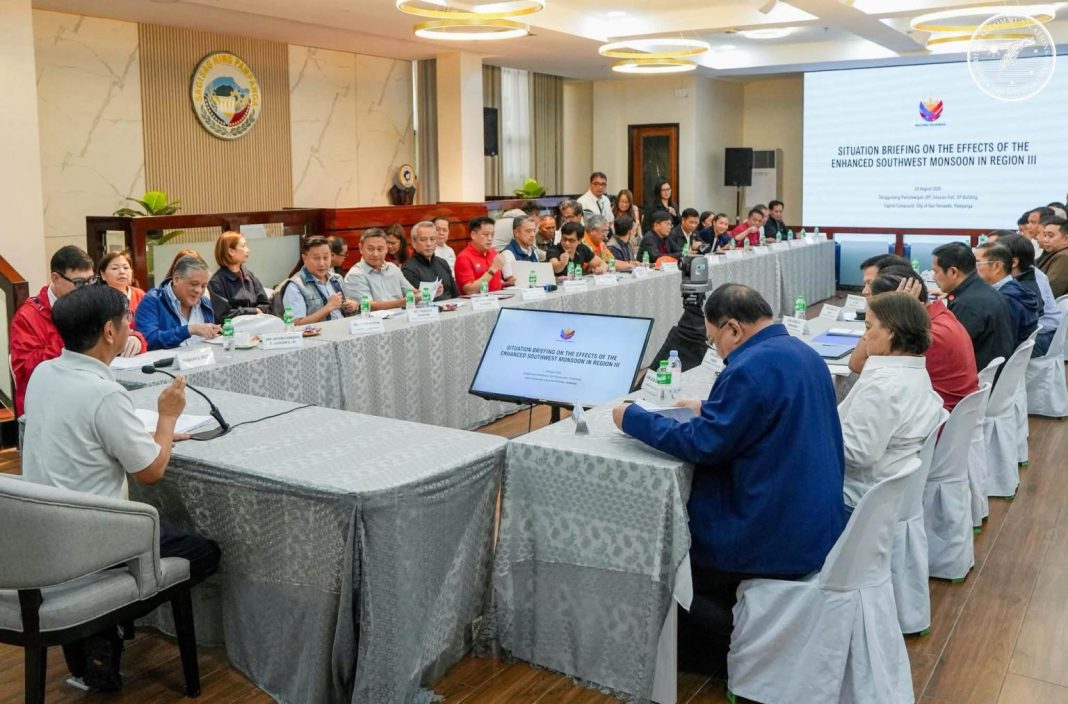
President Ferdinand R. Marcos Jr. visited the province of Pampanga on Monday to personally assess the massive flooding affecting over a million residents amid a series of severe weather disturbances.
The province remains under a State of Calamity following extensive damage caused by the combined effects of Super El Niño, Typhoon Maymay, Typhoon Luis, and the enhanced southwest monsoon.
-
Affected Population: Consolidated reports from the Provincial Disaster Risk Reduction and Management Council (PDRRMC) indicate that 253 barangays across 16 local government units (LGUs) are flooded.
-
Total Impact: The disaster has impacted 314,945 families, translating to 1,009,257 individuals.
-
Evacuation Efforts: A total of 3,142 families (11,366 individuals) are currently sheltered across 197 designated evacuation centers in 17 LGUs, while 2,599 families (11,575 individuals) have sought shelter outside designated centers.
During a high-level situation briefing at the Provincial Capitol in Barangay Sto. Niño, national and local officials presented ongoing relief and flood-control interventions.
President Marcos assured the public that the national government remains fully capable and active in delivering immediate assistance, highlighting ongoing support in food, shelter, and health services.
-
DSWD Assistance: The Department of Social Welfare and Development (DSWD) has disbursed P243.37 million worth of assistance to affected families, alongside P2.63 million in standby funds and 127,947 family food packs prepared at its Central Luzon regional office.
-
DPWH Operations: The Department of Public Works and Highways (DPWH) has actively deployed teams to conduct maintenance and declogging operations across drainage systems and waterways in Pampanga.
Following the briefing, President Marcos noted that the unprecedented volume of rainfall completely overwhelmed existing flood-control and management systems, emphasizing that the crisis reflects broader challenges posed by climate change. “Hindi lang dahil sa problema ng flood control project, kung hindi pati na sa lakas talaga ng ulan na hindi pa natin nakita sa kasaysayan ng Pilipinas. Ito ay ang naging resulta ng climate change,” said President Marcos.
The administration outlined a multi-phase approach to address perennial flooding:
-
Immediate Term: Prioritizing the rapid repair of damaged infrastructure and facilities once weather disturbances subside and floodwaters recede.
-
Medium Term: Constructing five Sabo River dams in Nueva Ecija originating from the Sierra Madre range to slow water velocity, reduce siltation, and capture water for agricultural, industrial, and household use.
-
Long Term: Studying major infrastructure initiatives including a road project extending toward Bataan as part of a comprehensive strategy addressing Manila Bay water issues, alongside major regional projects such as the Pampanga Delta Development Project (Phase 2), the Central Luzon Pampanga River Floodway, and the Rio Chico Control Structure.
Governor Lilia Pineda and other provincial executives from Bataan, Bulacan, Nueva Ecija, Tarlac, and Zambales joined Cabinet secretaries—including DSWD Secretary Rex Gatchalian, DPWH Secretary Vince Dizon, and DILG Secretary Juanito Victor Remulla—in coordinating unified recovery efforts.
“It is still a developing situation. Hindi pa tapos ito. So we will continue to monitor,” President Marcos concluded, assuring residents that all necessary measures will be pursued to mitigate the impact of the disaster.

