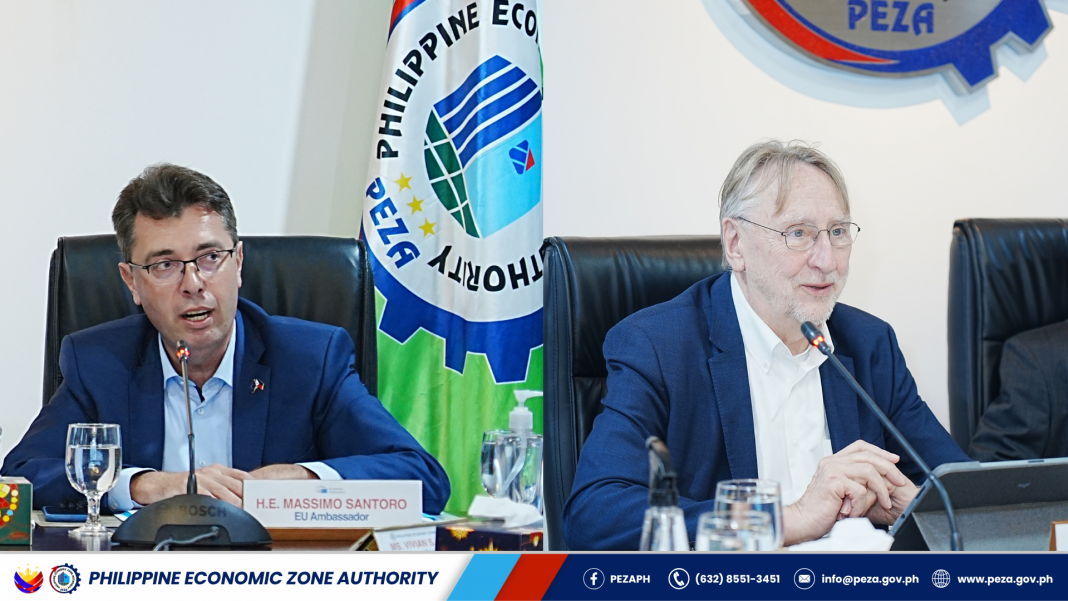
EU Parliamentarians expressed strong optimism about the direction of the EU-Philippines stating the current economic framework of the Generalized Scheme of Preferences Plus (GSP Plus) is an important transition toward a comprehensive bilateral free trade agreement between the two partners.
This was stressed by Ambassador Massimo Santoro, head of the 16-member EU delegation and EU ambassador to the Philippines, and Hon. Bernd Lange, the Chair of the European Parliament Committee on International Trade (INTA)and head of the Delegation from the Group of the Progressive Alliance of Socialists and Democrats (Germany) during their visit to the Philippine Economic Zone Authority (PEZA) on February 17, 2026. The delegation is comprised of Members of the European Parliament, including rapporteurs representing EU countries such as Sweden, Romania, Latvia, Spain, Lithuania and Belgium.
“Ambassador Santoro and INTA Chair Hon. Lange expressed their strong optimism about the direction of EU–Philippines relations, emphasizing a shared commitment to advancing a more comprehensive, transparent, and policy-based trade framework,” said PEZA Director General Tereso O. Panga.
In addition, Panga said that EU officials underscored the importance of the EU’s GSP+ as a cornerstone of current economic engagement, noting that ongoing discussions with the Philippines are aimed at gauging the “temperature” of its business environment—assessing policy stability, regulatory transparency, and competitive fairness as these factors are crucial to ensuring a smooth transition toward a comprehensive trade partnership between the European Union and the Philippines.
Managing transition from GSP+ to FTA
Notably, the Philippines is the only ASEAN member state with active EU GSP+ status since 2014, allowing duty-free entry for over 6,000 products.
The EU–Philippines trade relationship is currently anchored on the GSP+, which supported €2.2 billion in Philippine exports in 2024 and enabled stronger MSME participation in European value chains. Total bilateral trade reached €16.8 billion, underscoring the EU’s importance as a trade and investment partner.
However, with GSP+ set to expire in 2027, both sides recognize the urgency of concluding the PH–EU FTA to avoid trade disruptions and secure long-term market access.
DTI Secretary and PEZA Board Chair Cristina Roque, who is leading the FTA negotiation with EU, estimates that a successful FTA could unlock up to USD12 billion in additional export potential, particularly by addressing compliance challenges and improving awareness of EU market opportunities.
More EU investors
For his part, Panga told the EU delegation that more European investors are expected to expand and establish operations in the Philippines once the PH–EU FTA is finalized.
DG Panga also briefed the EU officials on the Philippines’ investment environment, reform development, strategic advantages of locating within PEZA ecozones, and PEZA’s role in supporting export-led and industrial growth.
He underscored the Philippines’ positioning as a competitive EU partner in Southeast Asia, citing strong services-sector growth, a deepening electronics and manufacturing base, and ongoing infrastructure modernization as key drivers of medium-term expansion.
DG Panga further outlined priority sectors where European capabilities align closely with Philippine and ASEAN growth trends for 2026–2030, including electronics manufacturing and supply chain services, logistics and infrastructure digitalization, and renewable energy development focused on grid resilience and energy storage.
PEZA system
During the open forum, members of the delegation raised questions on the specific conditions governing importation within PEZA ecozones. These include the differentiation of incentives between investments located inside and outside the Philippines and the European Union, and the eligibility criteria for micro, small and medium enterprises (MSMEs).
Other members focused more on the PEZA programs for attracting EU trade and investments, ease of doing business measures as well as digitalization and sustainability initiatives. The Romanian representative asked PEZA if they could share to their country the Philippine ecozone development strategy and digitalization initiatives, while the Belgian representative inquired about PEZA’s reverse trade program as a tool for integrating MSMEs into the ecozone value chain.