


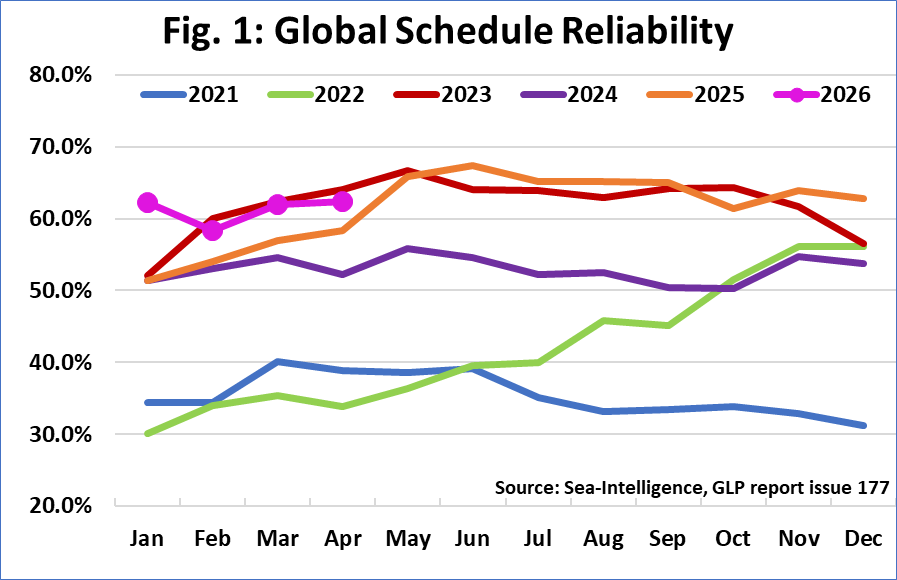
Sea-Intelligence has released issue 177 of its comprehensive 120-page Global Liner Performance (GLP) report, detailing maritime schedule reliability figures through April 2026 across 34 trade lanes and more than 60 carriers.
The latest data reveals that global industry schedule reliability reached its highest point of the year in April 2026, climbing 0.4 percentage points month-on-month (M/M) to hit 62.4%. This also marks a notable year-on-year (Y/Y) improvement, up 4.0 percentage points compared to April 2025.
Along with more predictable schedules, the average delay for late vessel arrivals saw a positive shift, dropping by 0.27 days month-on-month to 5.34 days. However, reflecting longer-term supply chain pressures, this delay figure remains 0.31 days higher than it was this time last year.
Among the top 13 global carriers, Maersk secured the top spot for reliability in April 2026, tracking at 76.1%, closely followed by Hapag-Lloyd at 75.1%.
-
60%–70% Range: 5 carriers
-
50%–60% Range: 5 carriers
-
Lowest Reliability: Wan Hai recorded the lowest score for the month at 39.6%.
While only five of the top carriers managed to improve their performance on a month-on-month basis, a sweeping 11 out of 13 carriers demonstrated clear year-on-year improvements.
The March/April 2026 data shows stark contrasts between major shipping alliances. The Gemini Cooperation led by a wide margin, recording an 85.0% reliability rate across “all arrivals” and 85.6% across “trade arrivals.” MSC followed with 73.4% for all arrivals and 72.3% for trade arrivals.
Meanwhile, the Premier Alliance lagged behind at 54.2% for both metrics, and the Ocean Alliance scored 67.6%.

