


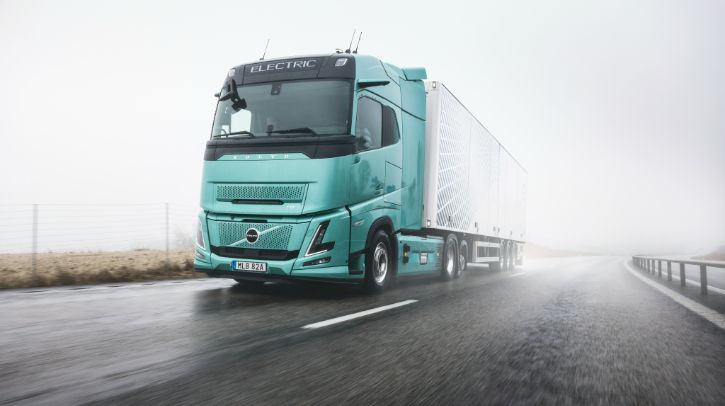
Volvo Trucks is expanding its heavy-duty vehicle lineup in 2026 with a multi-path powertrain strategy that combines advanced internal combustion engines, battery-electric trucks and hydrogen-based technologies aimed at the global logistics and mining sectors.
This was part of the financials report of Volvo Group President and CEO Martin Lundstedt and CFO Mats Backman at the company’s recent Volvo Group Q4 and full-year 2025 results and the press conference that followed.
Volvo’s technology rollout is being financed by a SEK 63 billion net cash position in its industrial operations and a 25.5 percent return on capital employed, giving it the capacity to invest in battery-electric, hydrogen and advanced combustion platforms in parallel.
The company’s 19 percent share of the European heavy-truck market and the strong uptake of the FH Aero also provide the production scale and service revenues that executives said are essential to sustaining the transition while vehicle demand normalizes in several regions.
The Swedish manufacturer is developing the technologies in parallel to give long-haul and heavy-duty operators immediate gains in fuel efficiency while preparing zero-emission solutions for routes and worksites where air quality rules and decarbonization targets are tightening.
In long-haul transport, Volvo has introduced the Volvo FH Aero and its battery-electric counterpart, the FH Aero Electric, as its flagship models. The internal combustion FH Aero uses a redesigned aerodynamic profile and the D13 Turbo Compound engine to cut fuel consumption by as much as 7 percent compared with the previous generation. The truck also replaces conventional side mirrors with a digital camera monitor system that reduces drag and improves the driver’s field of vision.
Volvo said it has delivered more than 10,000 gas-powered trucks worldwide as of February 2026. These vehicles run on bio-LNG and have a range of as much as 1,000 kilometers on a single tank, providing an alternative for fleet operators seeking lower emissions without shifting immediately to battery-electric vehicles.
The transition to electric regional and intercity transport is led by the FH Aero Electric, which uses a new e-axle that integrates the electric motors and transmission at the rear of the vehicle. The layout frees space for additional batteries, increasing installed capacity to 780 kilowatt-hours and allowing a driving range of as much as 600 kilometers.
Volvo is pairing the truck with the megawatt charging system for heavy vehicles. The system can charge the battery from 20 percent to 80 percent in about 45 minutes, a period that corresponds to a standard driver rest break on long-distance routes and is intended to reduce operational disruptions linked to charging.
Mining has become a key testing environment for the company’s electric and autonomous heavy-duty platforms. Volvo, working with Swedish mining group Boliden, has deployed FH Electric trucks in the Kankberg mine to move rock bolts and ore through steep underground tunnels. The absence of exhaust emissions improves working conditions and reduces the need for energy-intensive ventilation, which is one of the largest operating costs in underground mining.
The trucks also use regenerative braking to recover energy when descending into the mine and reuse it for the return climb to the surface. For open-pit mining and heavy construction, Volvo is offering the FMX Electric, a battery-electric truck designed to handle high payloads and operate on uneven terrain where high torque and traction are required.
While electrification is central to its strategy, Volvo continues to invest in internal combustion technology as part of its decarbonization roadmap. The company announced in 2024 that it is developing hydrogen-fueled engines using high-pressure direct injection, with on-road testing scheduled to begin in 2026. The engines are designed to deliver performance and durability comparable to diesel while producing near-zero carbon dioxide emissions at the tailpipe, a configuration intended for remote operations where charging infrastructure is limited but hydrogen can be transported and stored.
Volvo holds about a 19 percent share of the European heavy truck market and has delivered more than 5,700 battery-electric trucks in 50 countries. Its three-track technology strategy composed of battery-electric, fuel-cell electric and renewable-fuel combustion engines is aligned with its target of offering a fossil-fuel free product range by 2040. The countries with the largest uptake during the year were UK, France, Poland, Germany and Lithuania .

