


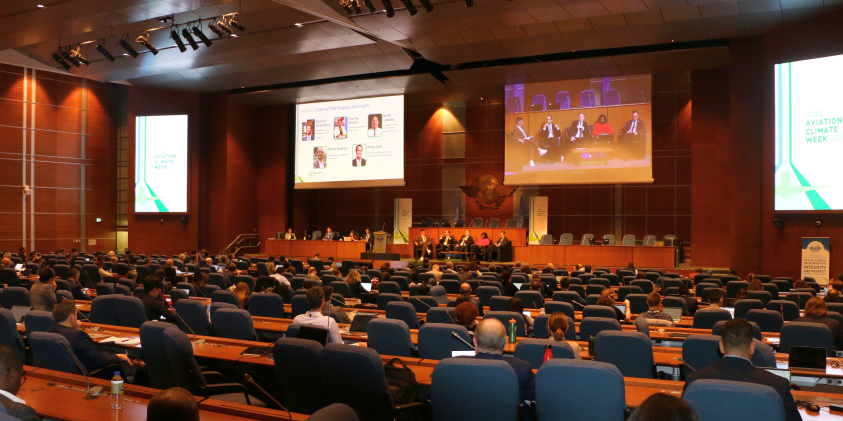
Day two of the International Civil Aviation Organization (ICAO) Aviation Climate Week turned a sharp focus toward the rapid scaling of Sustainable Aviation Fuels (SAF) and Lower Carbon Aviation Fuels (LCAF).
ICAO said while celebrating recent regulatory momentum, global aerospace and finance panelists issued a stark reminder: achieving the industry’s net-zero goals will require an estimated $3.2 trillion in investment by 2050, alongside a major shift toward harmonized global policies.
-
The Financial Challenge: Scaling SAF to required global levels presents a massive financing hurdle, potentially requiring up to $3.2 trillion over the next three decades.
-
The ICAO Solution: ICAO’s ACT-SAF programme has successfully transitioned from theory to action, delivering 18 feasibility studies with 17 implementation projects currently underway to support local business development.
-
The Policy Prescription: Panelists urged a transition away from fragmented regional mandates toward performance-based, tech-neutral frameworks that reward actual carbon reduction and offer long-term regulatory certainty to investors.
ICAO noted that while major markets have seen a boost in SAF production thanks to early regulatory frameworks, deep systemic challenges remain—particularly in developing nations. Investors currently face severe headwinds, including feedstock uncertainty, a lack of bankable long-term offtake agreements (agreements to buy fuel before it is produced), and the fragmented nature of regional regulations, which increases operational costs.
Furthermore, speakers noted that blending mandates alone do not generate sufficient demand at viable price points, leaving the fuel prohibitively expensive for many airlines.
To bridge this gap, discussions highlighted emerging market solutions:
-
Risk-Sharing Contracts: SAF aggregators are designing long-term contracts to spread financial risk evenly across the supply chain.
-
Development Bank Intervention: Multilateral lenders are increasingly stepping in to finance pioneering projects, directly resolving localized barriers to entry.
-
The ICAO Finvest Hub: This newly launched initiative is actively connecting clean energy projects with global capital while deploying de-risking mechanisms to make early-stage developments more attractive to private investors.
A key consensus from the panels was the necessity of maintaining ICAO’s technology-neutral stance. Rather than picking winning technologies, future policy must welcome a wide diversity of feedstocks and conversion methods.
Decarbonization performance will instead be strictly measured through robust certification and digital traceability systems. Panelists called for a unified, flexible ICAO governance structure that can recycle compliance revenues directly back into clean energy incentives—especially for developing states that require affordable finance.
The day’s discussions concluded on a fundamental truth: no single entity can scale sustainable aviation alone. While airlines are a critical engine for demand, successful execution requires early alignment among regulators, fuel producers, and financiers.
New public-private investment models are successfully gaining traction by using public funds to absorb early-stage risk, effectively mobilizing private capital. This collaborative ecosystem is increasingly being reinforced by both voluntary and compliance carbon markets, which are funneling fresh revenue streams directly into infrastructure projects.

