


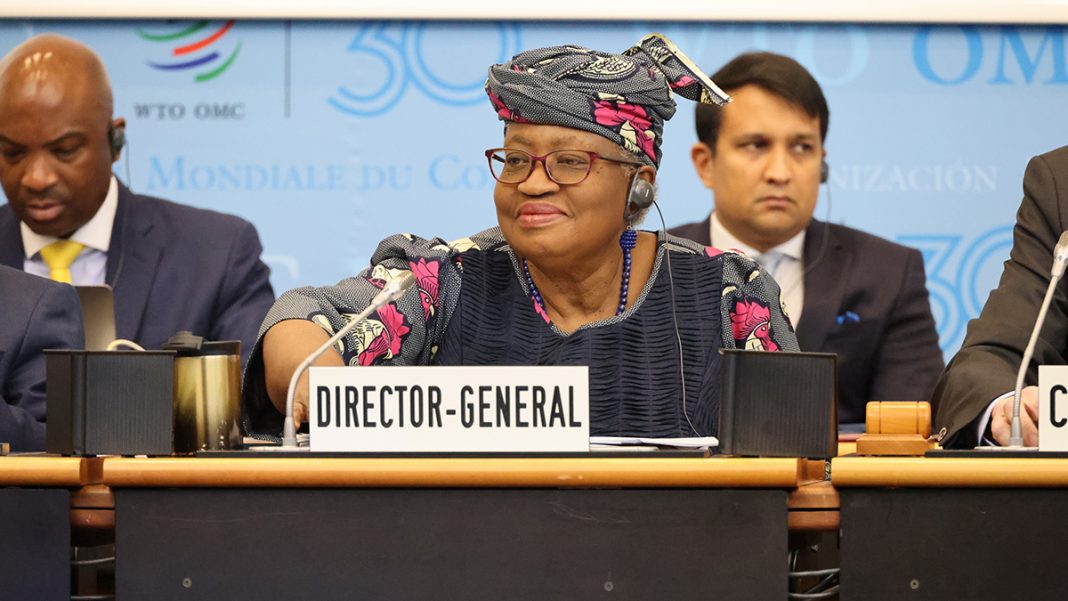
Senior executives from the world’s leading global shipping companies and maritime industry groups met with World Trade Organization (WTO) Director-General Ngozi Okonjo-Iweala to sound the alarm on intensifying operational and economic challenges threatening global goods trade.
While global supply chains have shown notable resilience, industry leaders emphasized that rerouting vessels around major chokepoints—particularly in the Gulf region—is driving up operational costs that will ultimately be passed on to consumers.
Industry representatives noted that while they continue to adapt and innovate, they are facing severe capacity constraints across transport networks. Shifting cargo away from disrupted maritime lanes to land-based routes or alternative ports is hitting a wall, as many of these alternatives are already entirely saturated.
One executive highlighted the staggering scale gap facing the industry: it can require approximately 70 freight trains to match the cargo capacity of a single modern container ship, underscoring the limitations of overland alternatives.
Beyond route extensions, the industry is grappling with severe operational bottlenecks. Multimodal logistics and the sudden pivot to alternative corridors have triggered widespread customs delays. Shipping leaders stressed that rising costs, route uncertainty, and logistical friction point to an urgent need for global investment in port and logistics infrastructure to restore predictable trade flows.
Amid these geopolitical and operational hurdles, executives strongly emphasized the critical importance of respecting multilateral norms and international agreements, specifically the longstanding principle of freedom of navigation.
Director-General Okonjo-Iweala reminded participants that maritime transport is the backbone of the global economy, carrying over 80 percent of global trade by volume. She called for immediate, strengthened cooperation between governments and the private sector to address these compounding vulnerabilities.
In response to industry concerns over customs delays, the Director-General urged member states to fully implement the WTO Trade Facilitation Agreement. She emphasized that accelerating the digitalization of customs procedures, expanding timely information-sharing, and exercising restraint in the use of new trade restrictions are vital to stabilizing global supply chains.
DG Okonjo-Iweala encouraged the industry leaders to maintain an active dialogue with the WTO Secretariat and other international bodies to ensure the escalating challenges of the maritime sector remain at the forefront of global policy discussions.
The meeting brought together top leadership from the world’s premier shipping and logistics enterprises, including:
-
MSC (Mediterranean Shipping Company)
-
CMA CGM
-
COSCO Shipping
-
Hapag-Lloyd
-
Ocean Network Express (ONE)
-
Evergreen Marine Corp.
-
Yang Ming
-
China Merchants Energy Shipping
The discussion also featured the heads of key global industry advocacy groups, including the International Chamber of Shipping (ICS), the International Federation of Freight Forwarders Associations (FIATA), and the World Shipping Council (WSC).

