


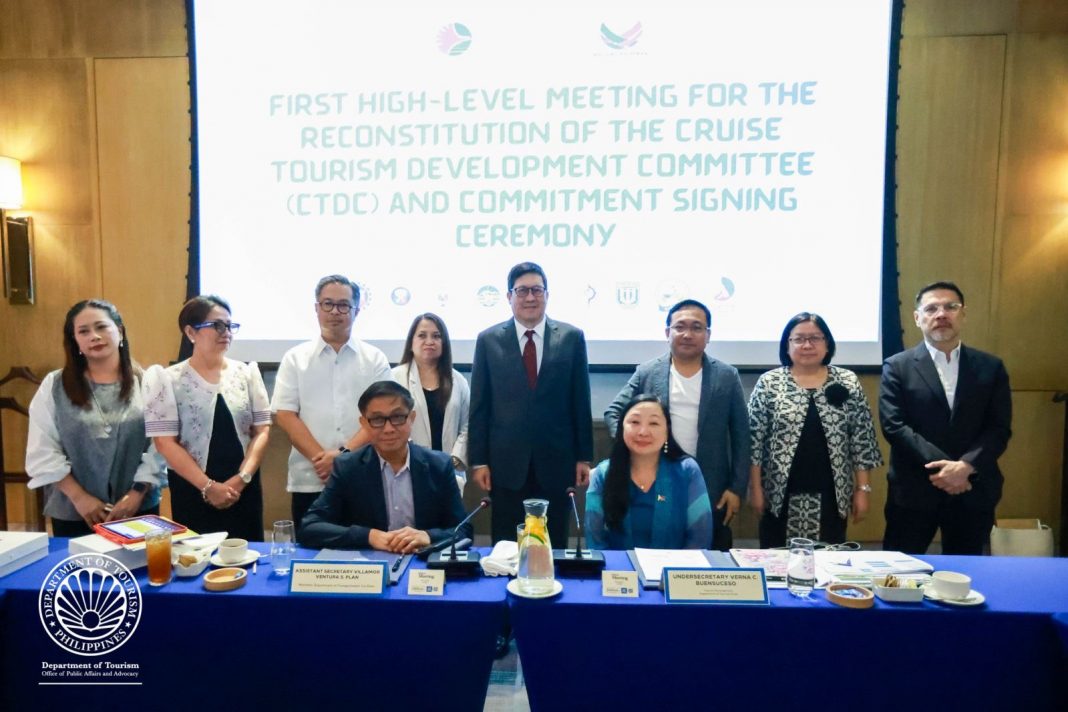
The Philippine government has signaled a bold new era for the country’s maritime tourism as the Cruise Tourism Development Committee (CTDC) convened its first high-level meeting following its official reconstitution.
Held at the Hilton Manila, the summit brought together the heads of key government agencies and private sector leaders to harmonize efforts in transforming the Philippines into a leading cruise hub in Asia.
The meeting, led by Department of Tourism (DOT) OIC Secretary Verna Buensuceso, focused on a unified “whole-of-government” approach to address long-standing bottlenecks in the industry and capitalize on the surging global interest in Philippine archipelago expeditions.
The discussions centered on five strategic pillars designed to modernize the Philippine cruise landscape:
-
Infrastructure Development: Accelerating the construction of dedicated cruise terminals and improving pier facilities through the Tourism Infrastructure and Enterprise Zone Authority (TIEZA) and the Philippine Ports Authority (PPA).
-
Policy Streamlining: Expanding the utilization of cruise visa waivers to encourage higher passenger volume and ease of entry for international travelers.
-
Digital Transformation: Harmonizing cruise tourism data and passenger manifest systems in coordination with the Department of Information and Communications Technology (DICT).
-
Operational Efficiency: Enhancing the “Ship-to-Shore” experience by refining the protocols of the Bureaus of Customs, Immigration, and Quarantine (BCIQ) to ensure seamless passenger processing.
-
Maritime Integration: Aligning tourism goals with the Maritime Industry Development Program (MIDP) to ensure sustainable and safe maritime operations. “The reconstitution of this committee marks a pivotal shift from individual agency efforts to a synchronized national strategy,” said OIC Secretary Buensuceso. “We are not just building ports; we are building a world-class experience that reflects the warmth and beauty of the Philippine islands.”
The high-level meeting saw active participation from the Department of Transportation (DOTr), Department of Foreign Affairs (DFA), and the Department of Public Works and Highways (DPWH). These agencies, alongside the Maritime Industry Authority (MARINA), outlined specific commitments to improve port-to-destination connectivity and maritime safety standards.
Private sector stakeholders also contributed insights on global market trends, emphasizing the need for competitive port fees and diversified shore excursion programs that highlight the Philippines’ unique cultural and natural heritage.
The summit concluded with a landmark Commitment Signing Ceremony. This formal agreement binds the member agencies to a sustained coordination mechanism, ensuring that the development of cruise tourism remains a priority in the national economic agenda.
By fostering an environment of ease of business and world-class infrastructure, the CTDC aims to significantly increase cruise calls and passenger arrivals by the end of 2026, creating thousands of jobs for local communities in key port cities.

