The UN Trade and Development (UNCTAD) warned in its second rapid assessment that what began as a disruption in a key energy corridor is now feeding through the entire global economy as ship transits down 95 percent, increasing financial pressure on developing countries, and 3.4 billion people already saddled with debt.
The UNCTAD update released on April 1 followed an initial assessment issued on March 10. The update confirmed a rapid worsening of global conditions since the escalation at the end of February, with risks now extending well beyond energy markets.
Trade and growth losing momentum
Based on the UNCTAD update, the strong growth at the start of 2026 is losing momentum. Growth in global merchandise trade is projected to decelerate from about 4.7 percent in 2025 to between 1.5 percent and 2.5 percent in 2026, as global demand weakens and uncertainty rises.
Global growth is expected to slow from 2.9 percent in 2025 to 2.6 percent in 2026, assuming the conflict does not intensify further.
UNCTAD further said that rising geopolitical tensions are increasing uncertainty, making economic outcomes harder to predict and further weighing on investment and trade.
The conflict is adding to already high global geopolitical risks, amplifying its effects beyond energy markets.
Shipping and insurance costs are rising together, compounding the pressure. Inflation is picking up at the same time, adding to financial instability. The escalation is also laying bare underlying fragilities, including weak growth, rising inequality and higher living costs.
If the situation persists, disruptions to trade and financial markets could deepen, increasing the risk of a broader, cascading crisis.
Ship transits
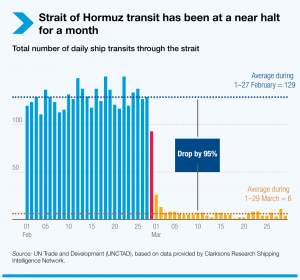
The Strait of Hormuz, a central artery for global energy trade, has seen activity fall to a near halt. Ship transits dropped from around 130 per day in February to just 6 in March – a collapse of about 95 percent.
The disruption is hitting a large share of global oil and gas supplies, with immediate consequences for production, trade and consumption worldwide. It is also spilling over into transport systems, including maritime routes, air cargo and port logistics.
Energy shocks have become the main channel through which the conflict is affecting trade and the global economy.
Fuel prices have risen sharply since the escalation on 28 February and remain elevated, while the cost of transporting oil has also increased significantly. These increases are feeding through supply chains, raising the cost of producing and moving goods across the world.
Not all shipping is affected equally. Oil and liquefied natural gas carriers, which rely heavily on Gulf routes, have been hit hardest, facing reduced volumes and higher risk costs. Other segments, such as container and dry bulk shipping, are more insulated but still affected by rising costs and disruptions.
If disruptions persist or intensify, damage to energy infrastructure could keep prices elevated for longer, prolonging inflationary pressures. Regions more dependent on Middle East energy imports, particularly South Asia and Europe, would be more exposed.
The strain is also visible across financial markets.
As uncertainty rises, investors are shifting away from riskier assets, selling stocks, bonds and currencies in developing countries. The sell-off has been more pronounced than in advanced economies. This is typical in periods of heightened risk.
Currencies in developing countries have weakened, making imports such as fuel and food more expensive. At the same time, countries are facing higher costs to borrow on international markets, making it harder to raise capital when it is most needed.
Borrowing costs have risen across developing regions in the weeks since the escalation.
Developing countries most exposed
The effects are most severe in developing economies.
Higher energy prices are increasing import costs, while weaker currencies amplify those pressures. At the same time, tighter financial conditions are reducing governments’ ability to respond.
The impact is compounded by rising import costs for energy, food and fertilizers, alongside weaker external demand. Even energy-exporting countries are unlikely to see clear gains, as higher import costs and increased volatility offset additional revenues.
In the most vulnerable economies, these pressures are also increasing risks to food security and complicating economic policy management.
These challenges come on top of existing debt vulnerabilities. Around 3.4 billion people live in countries that already spend more on servicing debt than on health or education, leaving little room to absorb new shocks.
A fast-moving global risk
Together, disrupted energy flows, rising prices, slower trade and tighter financial conditions are creating a broad-based global economic strain. As uncertainty rises, it is also weakening resilience and increasing the risk of a wider debt crisis.
If disruptions persist, UNCTAD said, the situation could evolve into a cascading crisis with far-reaching consequences for development.