


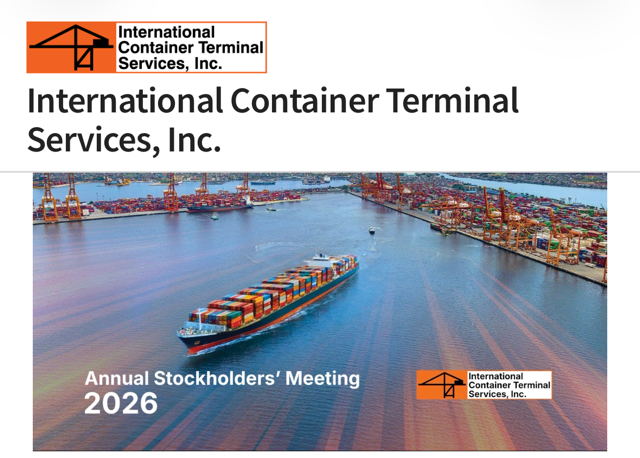
Manila-headquartered global port operator International Container Terminal Services Inc. (ICTSI) reported that net income attributable to equity holders of the parent was higher by 23 percent at USD1.05 billion in 2025, from USD849.8 million on higher cargo volumes.
ICTSI Chairman and President Enrique K. Razon Jr. reported Thursday during the Annual Stockholders Meeting that without non-recurring income and charges; new operations in Iloilo, Philippines and Batam, Indonesia, and the discontinued operations in Jakarta, Indonesia in 2024; net income attributable to equity holders would have grown 26 percent.
In 2025, the ultra billionaire said ICTSI handled consolidated volume of 14,501,189 twenty-foot equivalent units (TEUs) in 2025, 11 percent higher compared to the 13,066,949 TEUs handled in 2024.
Financial performance
Gross revenues from port operations for the year grew 18 percent to USD3.23 billion compared to the USD2.74 billion reported in the previous year due mainly from volume growth, tariff adjustments, and higher revenues from ancillary services at certain terminals. Revenues were dampened by the depreciation of the Mexican Peso, Brazilian Real and Australian Dollar.
Consolidated EBITDA increased 21 percent to USD2.14 billion, from USD1.78 billion in the prior year. EBITDA margin improved to 66 percent from 65 percent.
Consolidated cash operating expenses posted 11 percent higher at USD807.08 million compared to USD727.25 million. The increase was caused by higher volume, and increases in government-mandated and contracted salary rate adjustments and benefits. The increase would have been higher if not for our cost optimization measures and the favorable foreign exchange effects from costs in Brazilian Real, Mexican Peso and the Australian Dollar. Excluding the impact of new and discontinued operations, consolidated cash operating expenses would have increased 10 percent.
Fully diluted earnings per share increased 25 percent to USD0.510, from USD0.407 in 2024.
Robust balance sheet
Razon further emphasized that the group’s balance sheet remained robust with USD1.11 billion of cash as of the end of 2025 and gives us ample headroom to raise financing from our relationship banks and debt and capital markets of up to around USD5.4 billion. “The combination of these two, plus the strong cash generated from operations, provides us liquidity to undertake the planned capital expenditure program plus fund strategic mergers and acquisitions to further grow the company, refinance maturing loan obligations as they come due, and provide a return to equity holders,” he said.
Throughout the year, ICTSI continued to improve, expand and surpass past achievements of its terminals. The terminals in Nigeria, Congo, Iraq, Croatia, two terminals in Manila, Madagascar and Brazil, received top of the line equipment that further lifted productivity and attractiveness to clients.
In the meantime, Contecon Manzanillo (CMSA), Onne Multipurpose Terminal (OMT), and Baltic Container Terminal (BCT) undertook and completed million-dollar quay and yard expansion projects as demanded by increasing volumes. Rio Brasil Terminal (RBT) expansion is ongoing.
“Shipping lines continued to choose our terminals, bringing in new services and inaugural calls to Contecon Guayaquil, TecPlata, CMSA, Adriatic Gate Container Terminal (AGCT), BCT, Victoria International Container Terminal, Visayas Container Terminal and Manila International Container Terminal (MICT). MICT handled a record three million TEUs for the first time in a single year,” he added.
He cited that the Batu Ampar Container Terminal (BACT), with its partner PT Interport Sarana Infrastruktur Indonesia, as its fifth terminal in Asia Pacific and the second in Indonesia, outside of the Philippines.
Fund Management
Capital expenditures, excluding capitalized borrowing costs, amounted to USD650.44 million in 2025. These were mainly used for ongoing expansion works at CMSA, MICT, Manila NorthPort, Mindanao Container Terminal (MCT), Matadi Gateway Terminal (MGT), RBT and the new South Luzon Container Terminal (SLCT). These were also used for new equipment and upgrades at certain terminals including the upfront payment for BACT. Excluding the upfront payment for BACT, organic CAPEX would have amounted to USD572.49 million.
For 2026, the Group’s estimated capital expenditures for 2026 is USD740 million, which will be used mainly to complete the phase 3B expansion at CMSA, ongoing expansion at MICT, Manila NorthPort, MCT, SLCT, RBT, MGT and new equipment, upgrades and maintenance capex; plus four new expansion projects at Operadora Portuaria Centroamericana, VICT in Melbourne, Contecon Guayaquil and phase 4 at CMSA.
Contingency
When asked on ICTSI contingency plans given the ongoing tension in the Middle East and the closure of Strait of Hormuz, Razon said there has been no disruption in the delivery of diesel supply to the Philippines. He cited the Philippine government for being able to secure fuel supply from Russia, but noted uncertainty if the war will further prolong.
He said that ICTSI is also working with government and agencies to make sure the Philippines has continued fuel supply. But until the war is over, he said, prices will remain high and they have already adjusted tariffs globally to make up for the higher cost of fuel.

