


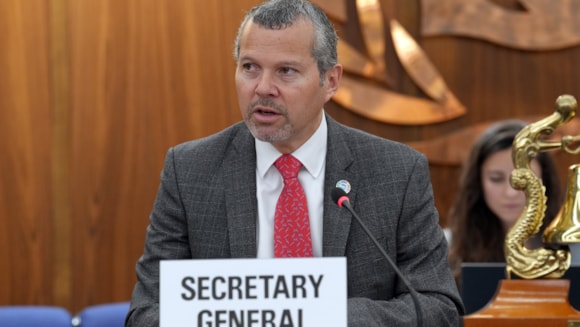
Arsenio Dominguez, Secretary-General of the International Maritime Organization (IMO), issued a decisive call for action regarding the escalating maritime security crisis.
Highlighting the “reckless” nature of ongoing attacks and seizures of commercial vessels, Dominguez emphasized that the safety of innocent seafarers must be the global community’s primary concern.
In a personal account shared during his address, Secretary-General Dominguez detailed a recent conversation with a seafarer who had been stranded in the Persian Gulf. The account provided a harrowing look at the reality faced by those currently manning global trade routes:
-
Constant Psychological Strain: Managing the stress of missiles passing overhead.
-
Physical Peril: The persistent danger of falling debris striking vessels.
-
Resource Depletion: The urgent need to ration essential supplies.
-
Communication Barriers: The profound difficulty of maintaining contact with families while in high-risk zones. “I cannot understand why companies would take risks and endanger seafarers’ lives,” Dominguez stated. “The situation in the region remains extremely volatile. De-escalation, meaningful actions, and restoring the freedom of navigation is the only way forward.”
While the individual Dominguez spoke with was able to depart safely, the IMO highlights a staggering remaining figure: nearly 20,000 seafarers have been stranded for more than seven weeks. These workers remain in a state of professional and personal limbo, uncertain of when they will be reunited with their families.
The Secretary-General outlined three critical pillars necessary to resolve the current maritime deadlock:
-
Immediate Ceasefire of Hostilities: An end to the targeted attacks on and seizures of commercial vessels.
-
Humanitarian Release: The immediate release of all ships and innocent seafarers currently being held.
-
Freedom of Navigation: Global cooperation to restore safe passage and protect the integrity of international shipping lanes.
The IMO remains committed to working with member states and international partners to ensure the protection of the men and women who serve at sea.
“There is much more work to be done,” Dominguez concluded. “The attacks and seizures are unacceptable.”

