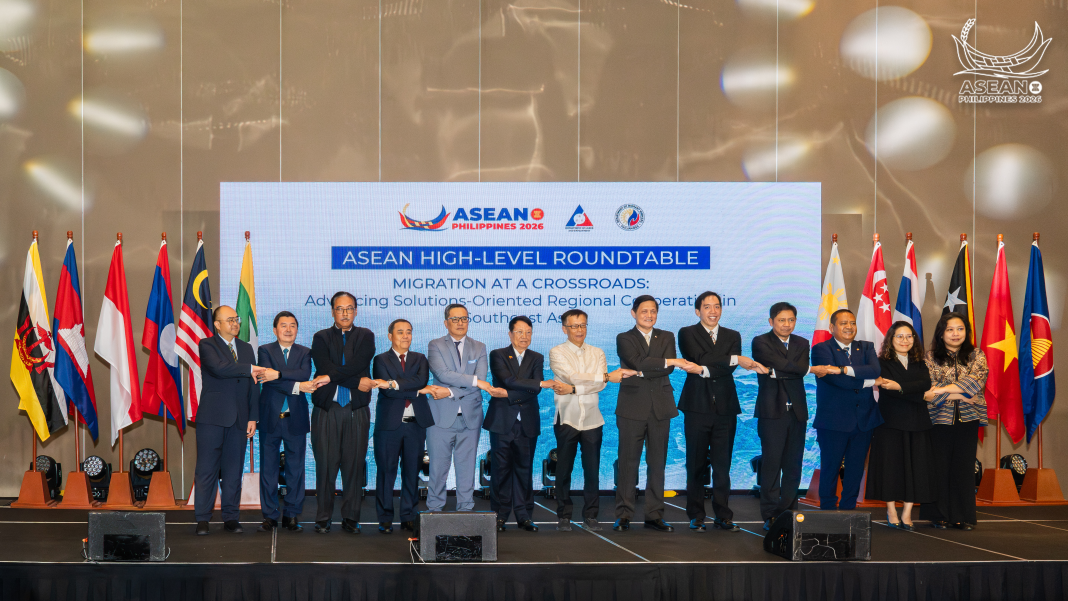
High-level representatives from the Association of Southeast Asian Nations (ASEAN) Member States gathered in Manila today for a landmark High-Level Roundtable titled “Migration at a Crossroads: Advancing Solutions-Oriented Regional Cooperation in Southeast Asia.”
Co-organized by the Philippines’ Department of Migrant Workers (DMW) and the Department of Labor and Employment (DOLE), in partnership with the International Organization for Migration (IOM), the event signals a proactive start to the Philippines’ ASEAN Chairship 2026. Under the theme “Navigating Our Future, Together,” the roundtable addressed the critical role of labor mobility in building a resilient, innovative, and people-centered regional community.
With over 24 million international migrants originating from ASEAN and 11 million migrants currently hosted within the region, migration remains a cornerstone of Southeast Asia’s economic and social fabric. The discussions emphasized that migration governance must evolve to meet modern “megatrends,” including:
-
Economic & Digital Transformation: Adapting to rapid urbanization and the digital economy.
-
Climate & Environmental Pressures: Addressing how disasters and climate change intensify mobility vulnerabilities.
-
Sectoral Sustainability: Supporting migrant workers who sustain vital industries such as healthcare, agriculture, manufacturing, and construction.
Leadership from the host nation reaffirmed their commitment to placing the human rights of workers at the forefront of policy.
“As ASEAN Chair, the Philippines is committed to advancing fair, orderly, safe, and regular labor migration through dialogue and regional initiatives that uphold migrants’ rights and dignity, including their families,” stated Benedicto Ernesto R. Bitonio Jr., Officer-in-Charge of the Department of Labor and Employment.
Hans Leo J. Cacdac, Secretary of the Department of Migrant Workers, added: “The Philippines continues to lead ASEAN efforts to place migrant workers at the center of policy, strengthening protection, preparedness, and regional cooperation in an increasingly complex mobility landscape.”
The Roundtable served as a strategic precursor to the International Migration Review Forum (IMRF) and the 48th ASEAN Leaders’ Summit. Participants reached a consensus on several forward-looking priorities:
-
Translating Policy into Practice: Moving beyond frameworks (like the 2017 ASEAN Consensus) to implement fair recruitment standards and accessible grievance mechanisms.
-
Skills Mobility: Enhancing the recognition of skills across borders to empower workers and fill regional labor gaps.
-
Holistic Support: Strengthening reintegration programs for returning migrants and support systems for families left behind.
-
Risk-Informed Governance: Developing “future-ready” policies that account for public health emergencies and environmental shocks.
The International Organization for Migration (IOM) reaffirmed its role as a long-standing partner, pledging continued support for ASEAN’s cross-cutting migration goals across all community pillars.
This initiative is a core component of the Action Plan 2026-2030 of the ASEAN Consensus on the Protection and Promotion of the Rights of Migrant Workers, ensuring that as the region grows, no worker is left behind.