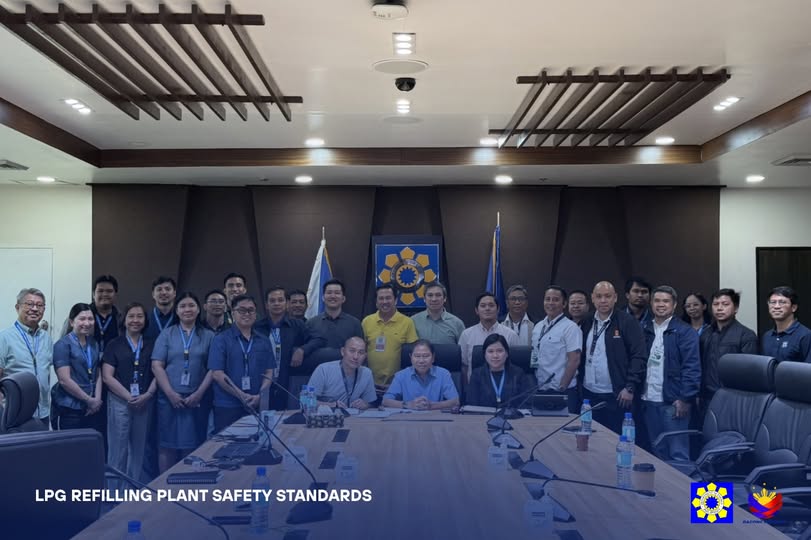
The Department of Energy (DOE), in its capacity as Chair of the Technical Committee on Petroleum Products and Facilities (TCPPF), has successfully led the finalization and approval of the draft Philippine National Standard (PNS) for Liquefied Petroleum Gas (LPG) Refilling Plant Requirements and Safety Practices. The draft standard is now set for endorsement to the Department of Trade and Industry–Bureau of Philippine Standards (DTI-BPS) for official promulgation.
This milestone represents a strong collaborative effort among key government agencies and industry leaders, including the Department of Environment and Natural Resources (DENR), major oil companies such as Petron Corporation, Chevron Corporation, and Shell plc, as well as the Safety Organization of the Philippines, alongside other relevant stakeholders.
Following more than a year of rigorous deliberations, the Technical Working Group (TWG) conducted a comprehensive series of consultations, technical workshops, and stakeholder engagements. These efforts ensured that diverse perspectives from across the LPG value chain were considered, allowing the committee to refine the draft standard with a focus on clarity, enforceability, and alignment with international best practices.
The updated PNS establishes enhanced requirements for the design, construction, operation, and maintenance of LPG refilling plants. It also introduces strengthened safety protocols aimed at minimizing risks, preventing accidents, and safeguarding workers, consumers, and surrounding communities.
According to the DOE, the new standard is a critical step toward improving compliance and operational integrity across LPG refilling facilities nationwide. By setting clearer guidelines and more robust safety benchmarks, the PNS is expected to elevate industry practices and promote a culture of safety and accountability within the downstream oil sector.
“The finalization of this standard underscores our shared commitment to public safety and industry excellence,” the DOE stated. “Through close coordination with our partner agencies and the private sector, we are ensuring that LPG operations in the country adhere to the highest standards of safety, efficiency, and environmental responsibility.”
Once promulgated by the DTI-BPS, the new PNS will serve as a key regulatory reference for LPG industry participants, supporting the government’s broader efforts to ensure a stable, secure, and sustainable energy supply for Filipino households and businesses.