


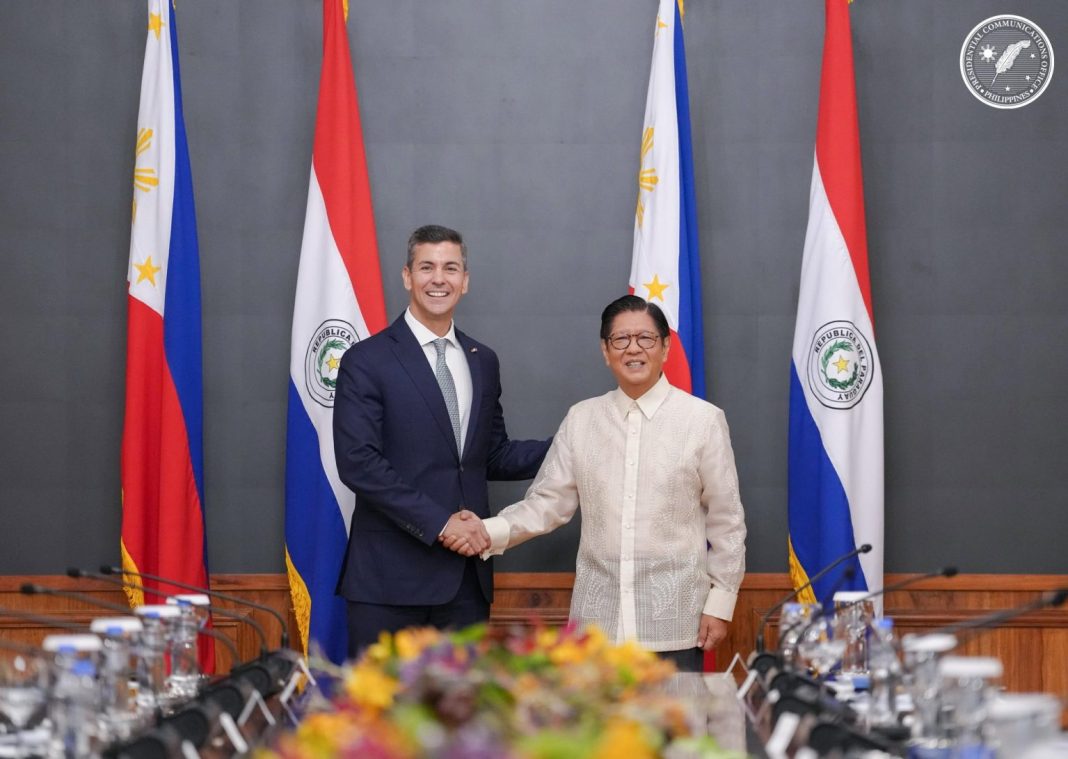
In a landmark move to strengthen its diplomatic and economic ties with Asia, Paraguayan President Santiago Peña Palacios announced on Monday Paraguay’s formal intention to accede to the Treaty of Amity and Cooperation (TAC) in Southeast Asia.
The strategic announcement was made during a joint press conference with President Ferdinand R. Marcos Jr. at Malacañang Palace, amid President Peña’s official visit to Manila. The Philippines currently serves as the Chair of the Association of Southeast Asian Nations (ASEAN) for 2026.
President Peña emphasized that Paraguay’s bid to join the TAC is far more than a diplomatic formality, framing it as a calculated step forward in the country’s global foreign policy.
“This decision reflects our firm determination to integrate into the regional dialogue and cooperation mechanisms in line with the principles of peace, respect for sovereignty, and the peaceful settlement of disputes that have historically guided Paraguay’s foreign policy,” President Peña stated. “It is a strategic declaration that positions Paraguay as an actor committed to stability and multilateralism in the Indo-Pacific.”
By acceding to the treaty, Paraguay aims to actively participate in Southeast Asia’s dynamic regional dialogue, opening new avenues for trade, investment, and multilateral cooperation.
Established in 1976, the TAC serves as a foundational accord promoting peaceful coexistence, mutual respect, and friendly cooperation. While originally limited to Southeast Asian nations, the treaty was amended in 1987, 1998, and 2010 to allow accession by non-regional states and international organizations. Paraguay is poised to join 58 High Contracting Parties who have already signed onto the pact.
President Marcos Jr. welcomed the expression of intent, signaling a mutual desire to bridge Latin American and Southeast Asian partnerships. The formal notification has been conveyed to the Philippine government to initiate the accession process within ASEAN.
The TAC is a binding treaty prescribed by ASEAN to govern interstate relations in the region and beyond. It operates on the core principles of mutual respect for independence, sovereignty, equality, territorial integrity, and national identity of all nations, alongside non-interference in internal affairs and the peaceful settlement of differences.

