


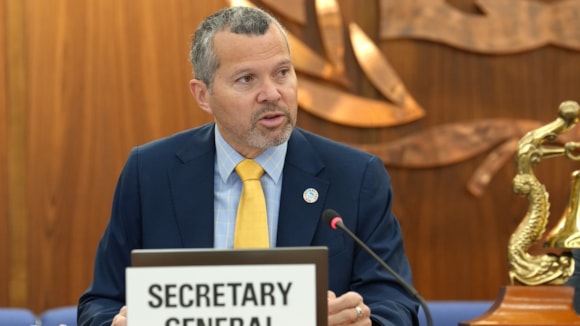
International Maritime Organization (IMO) Secretary-General Arsenio Dominguez opened the 111th session of the Maritime Safety Committee (MSC 111) with an urgent call for geopolitical factions to prioritize human life and break the diplomatic deadlock stalling the evacuation of stranded seafarers in the Strait of Hormuz.
Speaking to distinguished delegates, Secretary-General Dominguez addressed the intensifying humanitarian and economic crisis in the region, where a significant number of civilian seafarers remain confined to their vessels under severe psychological pressure and sustained security threats.
“This is an unacceptable situation for a civilian workforce,” Dominguez stated. “Beyond the human cost, the continued immobilization of ships in and around the Gulf carries serious consequences for global trade, energy supply, and economic stability. The longer this situation persists, the greater the risk of a serious maritime incident.”
The Secretary-General revealed that while the IMO has been mandated to facilitate the establishment of safe maritime corridors for evacuation—a plan firmly anchored in international law—implementation remains blocked by ongoing political disagreements.
“There are practical solutions to implement this plan,” Dominguez emphasized. “What is missing is not a legal basis, but the ability to reach agreement without further delay, in the interest of safety, responsibility, and humanity.”
In addition to the crisis in the Strait of Hormuz, the Secretary-General raised alarms over the resurgence of piracy and armed robbery off the coast of Somalia. Warning that hard-won progress in recent years remains fragile, he urged flag States and industry representatives to eliminate complacency and strictly enforce Best Management Practices (BMP) in high-risk areas.
Turning to the Committee’s formal agenda, which aligns with this year’s World Maritime Day theme, “From Policy to Practice,” the Secretary-General outlined critical regulatory milestones scheduled for the session:
-
SOLAS Amendments: The Committee is expected to consider and adopt vital amendments to the International Convention for the Safety of Life at Sea (SOLAS) and several key codes, reinforcing the global maritime safety framework.
-
The MASS Code: Delegates will advance work toward finalizing the first international code for Maritime Autonomous Surface Ships (MASS). This landmark safety-driven regulatory framework aims to responsibly integrate technological innovation without compromising the critical role of the human element or accountability.
The session marks the first under the leadership of the newly appointed MSC Chair, Mr. Theofilos Mozas of Greece. Expressing full confidence in the Chair and the Secretariat, Mr. Dominguez called on all Member State delegations to actively collaborate to achieve successful, tangible outcomes for global maritime safety.

