


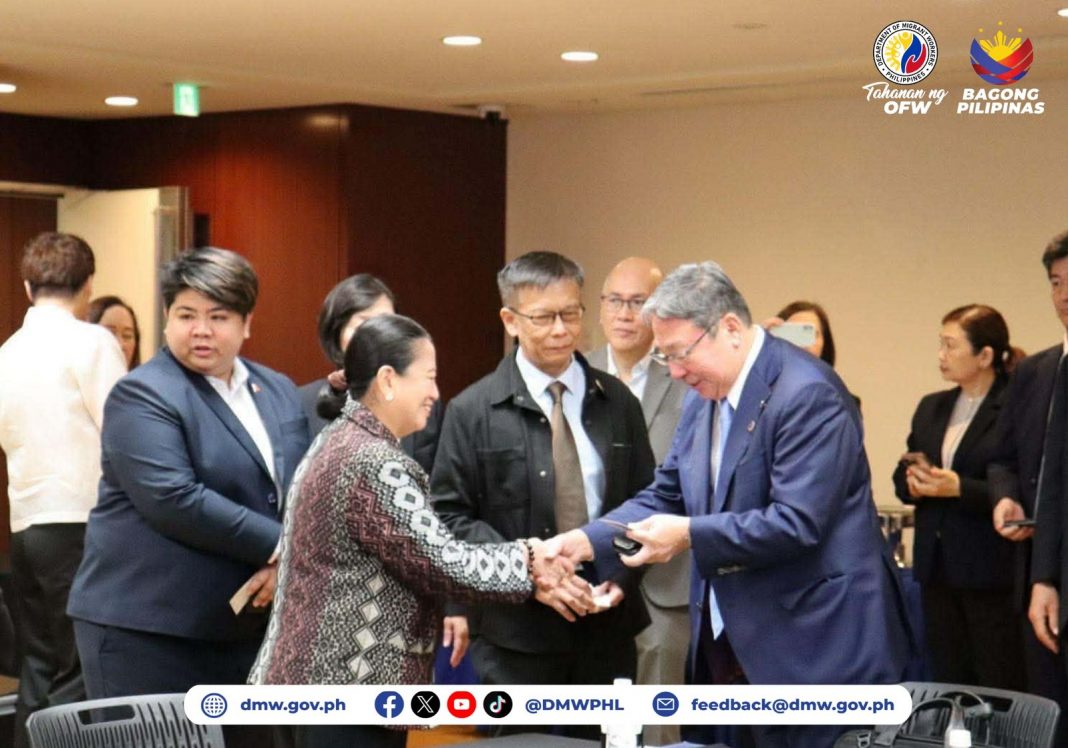
Philippine government officials and Japanese maritime stakeholders concluded a high-level dialogue today at the Philippine Embassy in Tokyo, reaffirming a joint commitment to the welfare, safety, and competitiveness of Filipino seafarers.
The talks—held on the sidelines of President Ferdinand R. Marcos, Jr.’s State Visit and the 70th anniversary of Philippine–Japan relations—focused on security in volatile shipping lanes, administrative digitalization, and expanded psychosocial support for seafarers.
The Philippine delegation was led by Department of Migrant Workers (DMW) Secretary Hans Leo J. Cacdac, Overseas Workers Welfare Administration (OWWA) Administrator Patricia Yvonne M. Caunan, and DMW Undersecretary Felicitas Q. Bay. They met with representatives from the Japanese Shipowners’ Association, the International Mariners’ Management Association of Japan, and the All Japan Seamen’s Union.
Key outcomes and commitments
- Japan Desk established: The DMW announced a dedicated Japan Desk to streamline communication and expedite labor coordination with Japanese principals, improving response times and case handling.
- Enhanced safety and emergency support: In light of disruptions in the Persian Gulf and Red Sea, the Philippine delegation affirmed that labor offices in Saudi Arabia, Qatar, and the United Arab Emirates are prepared to provide emergency relief and evacuation assistance for affected seafarers.
- Expanded psychosocial and welfare services: DMW and OWWA detailed an expanded support package that includes online mental health consultations and the rollout of Seafarers’ Welfare Centers—featuring medical clinics and short-term housing—beginning in Manila and at regional hubs.
- Administrative digitalization and efficiency reforms: To address bottlenecks flagged by Japanese shipowners, Undersecretary Bay described ongoing system reforms, including an online employment contract verification system for land-based workers, digital accreditation, and streamlined transaction flows aimed at reducing red tape and shortening crew-change lead times.
- Continued collaboration and quarterly consultations: Both sides agreed to form a Japan-focused working group and to meet quarterly for policy consultations. They also reaffirmed cooperation to improve tracking systems for seafarers in high-risk zones, expand mediation to curb predatory litigation, and support Filipino seafarers’ competitiveness amid the maritime sector’s digital and green transition.
“Today’s dialogue is more than just a meeting. It is an opportunity for us to listen to one another, strengthen our partnership, and ensure that the welfare, protection, and future of Filipino seafarers remain at the center of our shared efforts,” said Secretary Hans Leo J. Cacdac, emphasizing the government’s responsibility to safeguard workers amid rising geopolitical risks.
Next steps:
- Operationalize the Japan Desk and publish contact protocols.
- Launch online mental health consultation services and begin opening Seafarers’ Welfare Centers at designated locations.
- Continue DMW digital reforms and deploy the online contract verification and digital accreditation systems.
- Convene the inaugural meeting of the Japan-focused working group and schedule quarterly policy sessions.

