


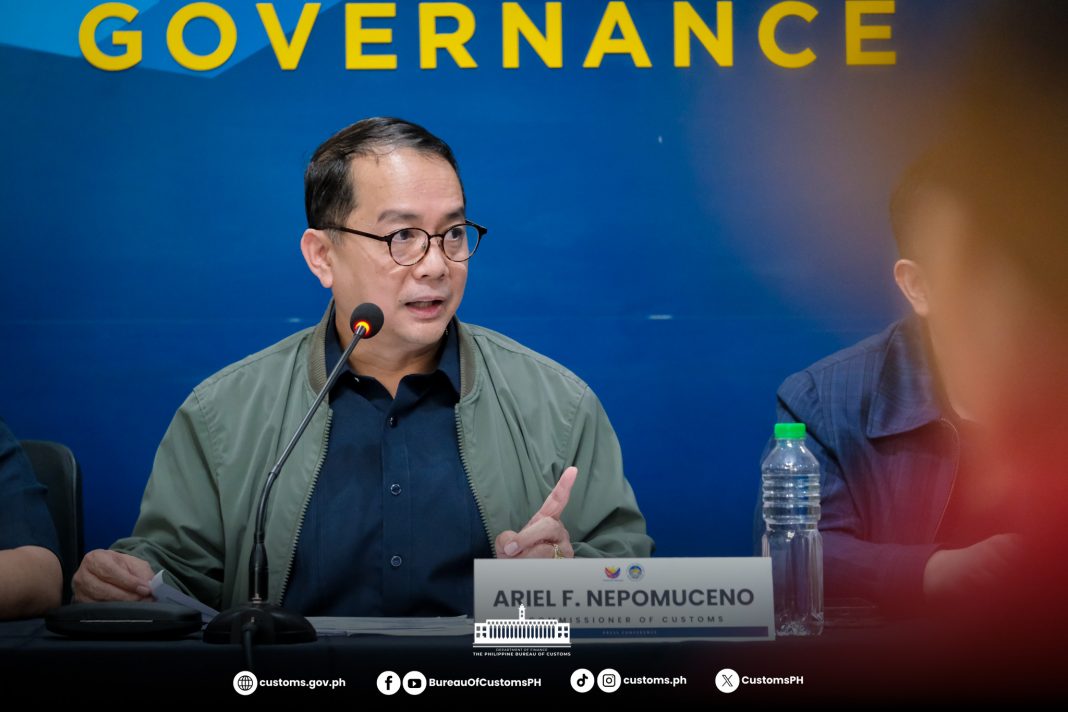
The government is considering reviving a pending Joint Administrative Order (JAO) that seeks to regulate fees charged by international shipping lines, a move aimed at reducing logistics costs and improving the ease of doing business in the country.
In a chance interview, Bureau of Customs (BOC) Commissioner Ariel F. Nepomuceno said the Department of Finance (DOF) is pushing for the implementation of the JAO.
“And I think Secretary Frederick Goh will push for that,” the commissioner said.
The proposed JAO, crafted during the administration of former President Rodrigo Duterte, was spearheaded by the Department of Trade and Industry (DTI), the Department of Transportation (DOTr), and the DOF to address what stakeholders described as excessive shipping charges and high logistics costs.
“But it wasn’t finally signed by the former Secretary Sonny Dominguez. I don’t want to guess why, they have their reasons. So, it is pending right now,” Nepomuceno said.
Once the concerned government agencies sign the JAO, Nepomuceno expects the regulation of charges imposed by international shipping lines to finally take effect.
“There are many, the freight cost is just one,” he lamented.
According to the commissioner, other charges include security fees, insurance, balancing fees, and other surcharges that contribute to the country’s high logistics costs and make Philippine imports and exports less competitive.
“You’ll find out that the total logistics cost in bringing in and bringing out containers to and from the Philippines are higher compared to our neighbors. The lowest is times two. There are times three and a half,” he pointed out.
An earlier policy brief by the International Finance Corp. showed that logistic costs ate up about 27 percent of sales of manufacturing firms in the Philippines, making it the largest cost to sales ratio when compared to the other countries in Southeast Asia. In the Philippines, the IFC survey covered about 159 companies in major cities such as Clark, Cebu, General Santos and those in Metro Manila. The majority of these are small- and medium-sized enterprises.
Defining the regulator
The pending JAO also seeks to clarify which government agency should oversee and regulate international shipping lines, particularly the fees they charge importers and exporters.
Under the pending JAO and related legislative proposals, such as the Philippine Shippers’ Act, the Maritime Industry Authority (MARINA), an attached agency of the DOTr, is expected to play a primary role in supervising and regulating local fees and charges imposed by international shipping lines, freight forwarders, and non-vessel operating common carriers (NVOCCs).
The proposal also includes the creation of an oversight body, such as a Philippine Shippers’ Board or Shippers’ Protection Office, which would hear complaints involving unreasonable surcharges, demurrage fees, and container deposits.
Nepomuceno cited several international models for regulating charges imposed by shipping lines.
In the United States, he noted that function is performed by the Federal Maritime Commission. In Japan, the responsibility falls under the Ministry of Land, Infrastructure, Transport and Tourism. Other economies assign the task to dedicated maritime or transport regulators rather than customs authorities, although Nepomuceno said the JAO could also designate the BOC to perform the role.
The commissioner, however, said MARINA appears to be the most logical choice because it already regulates domestic shipping rates.
MARINA is also the agency that accredits international shipping companies and maritime enterprises operating in the Philippines. The agency regulates, licenses, and accredits overseas shipping companies, manning agencies, and ship management enterprises to ensure compliance with national laws and international maritime safety standards.
“To me, nearest is Marina. But if given to BOC, we are willing, of course, to do that,” he said.
Nepomuceno stressed that it is time to regulate the charges imposed by international shipping lines, which he said are a major factor behind the country’s high logistics costs.
“For congestion, they are also. Yes, we are also a victim of that,” he said.

