


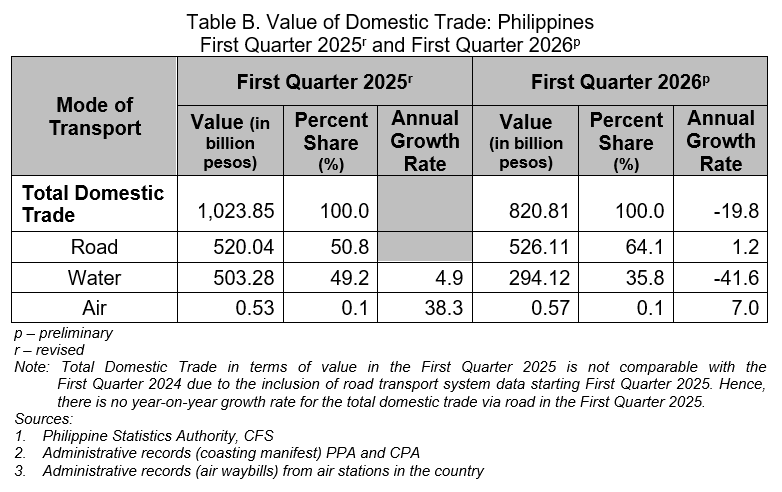
The Philippine Statistics Authority (PSA) reported that the country’s domestic trade reached a total value of ₱820.81 billion in the first quarter of 2026, reflecting the continued movement of goods across regions and highlighting the vital role of land-based logistics in sustaining domestic commerce.
According to the PSA’s latest Domestic Trade Statistics, the total volume of domestic trade was recorded at 10.17 million tons during the period. While this represents a 35.3 percent decline from the 15.72 million tons recorded in the first quarter of 2025, the data underscores the resilience of key trade corridors and commodity sectors that continue to support economic activity nationwide.
Road transport remained the primary mode of trade movement, accounting for 50.6 percent of total commodity volume and 64.1 percent of total trade value. Commodities transported by road reached 5.15 million tons, valued at ₱526.11 billion, posting a 1.2 percent increase in value compared to the same period last year despite lower shipment volumes.
Water transport accounted for 49.3 percent of total trade volume, with commodities reaching 5.02 million tons valued at ₱294.12 billion. Meanwhile, air transport handled 4.57 thousand tons of commodities worth ₱570 million, recording a 7.0 percent increase in value, reflecting sustained demand for high-value and time-sensitive goods.
Among commodity groups, mineral products registered the highest outflow volume at 3.07 million tons, representing 30.2 percent of total domestic trade volume. This was followed by:
- Prepared foodstuffs, beverages, tobacco, and nicotine-containing products with 2.50 million tons (24.6 percent); and
- Vegetable products with 2.40 million tons (23.6 percent).
These figures highlight the continued importance of the agriculture, food manufacturing, and extractive industries in supporting interregional trade and supply chains.
Regional data showed that the Davao Region (Region XI) posted the highest outflow volume of traded commodities at 1.94 million tons, accounting for 19.1 percent of the national total. The region was followed by:
- Central Luzon (Region III) with 1.61 million tons (15.8 percent); and
- CALABARZON (Region IV-A) with 1.53 million tons (15.1 percent).
These regions continue to serve as major production, manufacturing, and distribution hubs that facilitate the movement of goods across the country.
On the receiving end, the National Capital Region (NCR) recorded the highest inflow volume of domestic trade at 2.36 million tons, accounting for 23.2 percent of total traded commodities. NCR was followed by:
- SOCCSKSARGEN (Region XII) with 1.73 million tons (17.0 percent); and
- Central Luzon (Region III) with 1.13 million tons (11.1 percent).
The figures reflect the sustained demand for goods in major consumption and industrial centers, reinforcing the importance of efficient logistics and transportation networks in ensuring the smooth flow of commodities nationwide.
The PSA data highlights the critical role of domestic trade in linking producers, manufacturers, and consumers across regions. Despite declines in overall trade volume and value compared to the previous year, the growth in the value of road- and air-transported commodities suggests continued opportunities for logistics modernization, supply chain efficiency, and regional economic integration.
As the Philippines advances its infrastructure and connectivity agenda, strengthening interregional trade corridors remains essential to enhancing market access, supporting local industries, and promoting inclusive economic growth across the country.

