


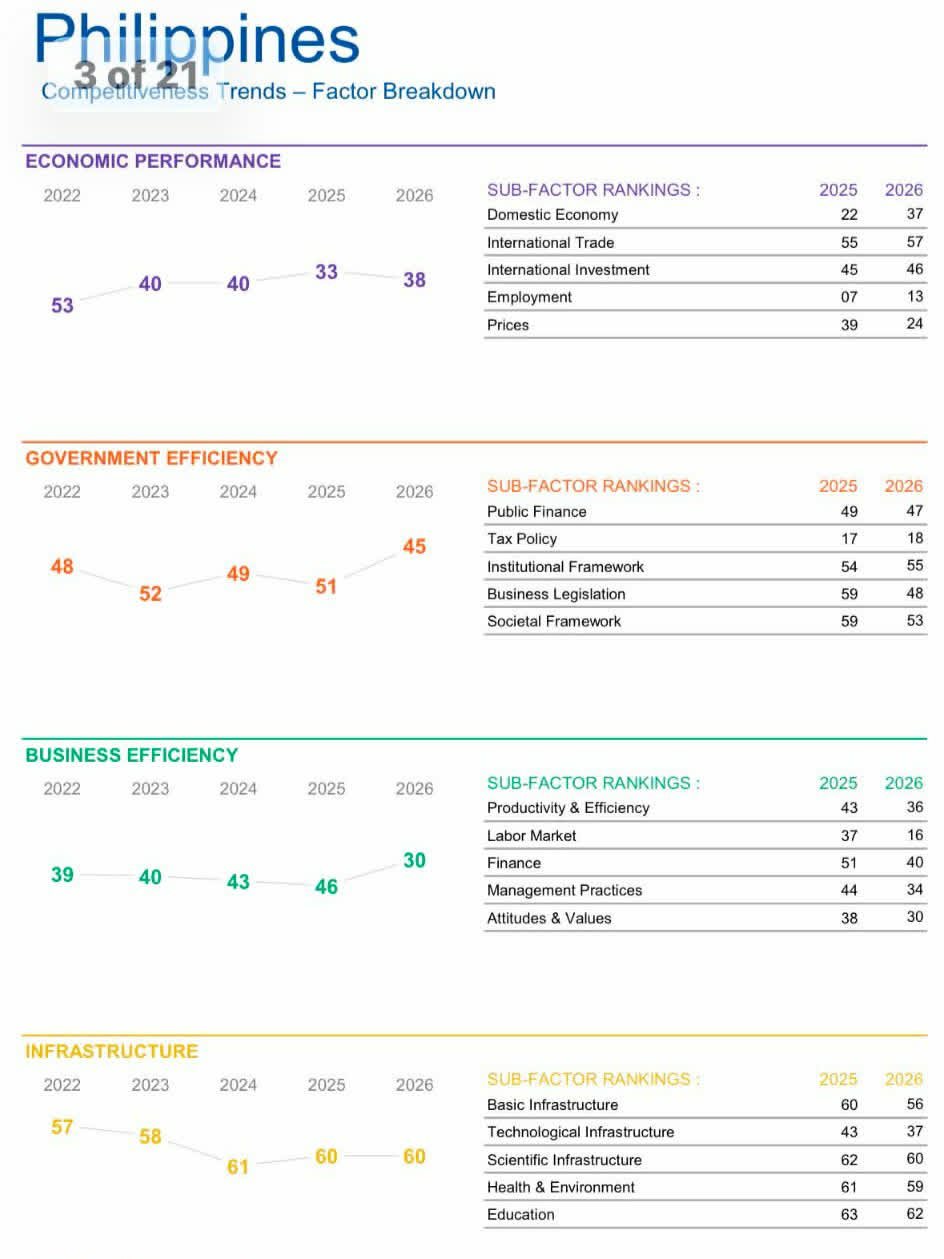
The Philippines improved its competitiveness ranking by four places to 47th in 2025 from 51st in 2024, according to the latest World Competitiveness Report, which measures the competitiveness of 70 economies in terms of ease of doing business.
The report, released on June 18, showed that the Philippines posted its biggest improvement in business efficiency, climbing to 30th place from 46th last year. The country’s anti-corruption drive was cited as one of the contributing factors.
The business efficiency ranking covers the sub-factors of productivity and efficiency, labor market performance, finance, management practices, and attitudes and values.
The Philippines also improved its ranking in government efficiency, rising to 46th from 51st. This pillar measures public finance, tax policy, institutional framework, business legislation, and societal framework.
In terms of infrastructure, the Philippines maintained its ranking at 60th.
However, the country’s ranking in economic performance slipped to 38th from 33rd last year.
The Philippines’ overall ranking was boosted by improvements in 15 major indicators, including AI-related patent publications, long-term unemployment, gender parity in access to financial services, consumer price inflation, bureaucracy, inbound student mobility, pension funding, the parallel economy, cybersecurity, tax evasion, brain drain, income distribution among the lowest 40 percent, bribery and corruption, venture capital, and government subsidies.
On the other hand, declines were recorded in population growth, real growth in gross fixed capital formation, secure internet servers, internet users, patent grants, stock market capitalization, protectionism, youth unemployment, economic resilience, unemployment rate, exports of commercial services, exchange rate stability, high-tech exports, and workforce productivity.
The report identified several challenges for the Philippines in 2026, including restoring growth momentum while managing inflationary pressures arising from external shocks.
Another challenge is strengthening institutions to address bureaucratic inefficiencies and mitigate corruption risks. Ensuring timely government responses to energy and food supply shocks was also cited as a key concern. In addition, the report highlighted the need to address persistent challenges in access to and the quality of basic education.
The study also underscored the importance of facilitating investments in renewable energy and climate risk mitigation. Meanwhile, the report noted that respondents to the Executive Opinion Survey were asked to select five key factors that make their economy attractive from a list of 15 indicators.
The factors identified were a skilled workforce, open and positive attitudes, high educational attainment, economic dynamism, cost competitiveness, quality of corporate governance, effective labor relations, a business-friendly environment, policy stability and predictability, access to financing, reliable infrastructure, an effective legal environment, a strong R&D culture, government competency, and a competitive tax regime.

