


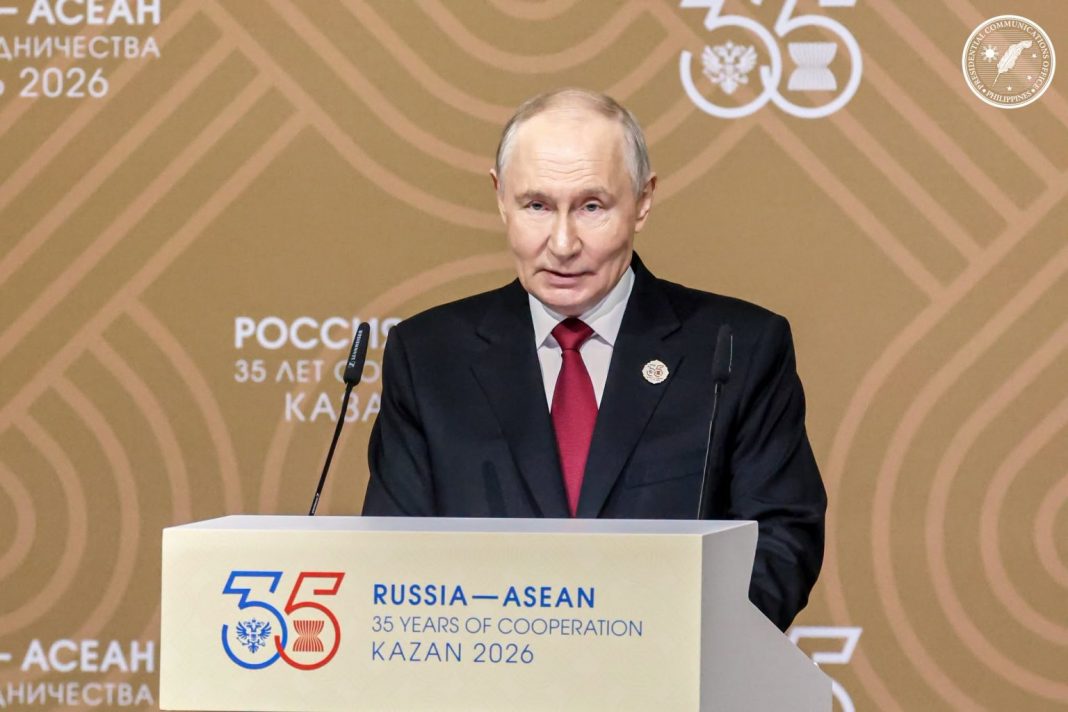
In a historic bilateral meeting held on the sidelines of the ASEAN-Russia Summit, Russian President Vladimir Putin and Philippine President Ferdinand R. Marcos Jr. marked a significant milestone in diplomatic relations, highlighting a unique shared celebration and a half-century of partnership.
President Putin opened the meeting by extending his warmest congratulations to President Marcos and the Filipino people on the occasion of Philippine Independence Day, celebrated annually on June 12.
In a notable observation, President Putin pointed out that June 12 also marks Russia’s national holiday, the “Day of Russia.” “Symbolically, we in Russia also celebrate our national holiday, the Day of Russia, on the same date, the 12th of June,” Putin noted. “This is a happy coincidence that reflects our longstanding ties.”
President Marcos reciprocated the warm sentiments, emphasizing that the bilateral meeting comes at a pivotal moment. This year marks the 50th anniversary of formal diplomatic ties between the Philippines and Russia.
The Philippine leader expressed his deep gratitude to President Putin, the Russian government, and its people for the exceptional hospitality extended to the Philippine delegation and fellow ASEAN member states attending the summit.
The relationship between the two nations has evolved through decades of geopolitical shifts, remaining grounded in mutual respect:
| Milestone Year | Event |
| June 1976 | Formal diplomatic relations are established between the Philippines and the Union of Soviet Socialist Republics (USSR). |
| December 1991 | Following the dissolution of the USSR, the Philippines formally recognizes the Russian Federation as its successor state. |
| Present | The Philippines continues to pursue a dynamic partnership with Russia rooted in cooperation, pragmatism, and shared economic and regional interests. |
Moving forward, both nations reaffirmed their commitment to deepening cooperation across various sectors, leveraging their historic milestone to foster stronger regional stability and mutual growth.

