


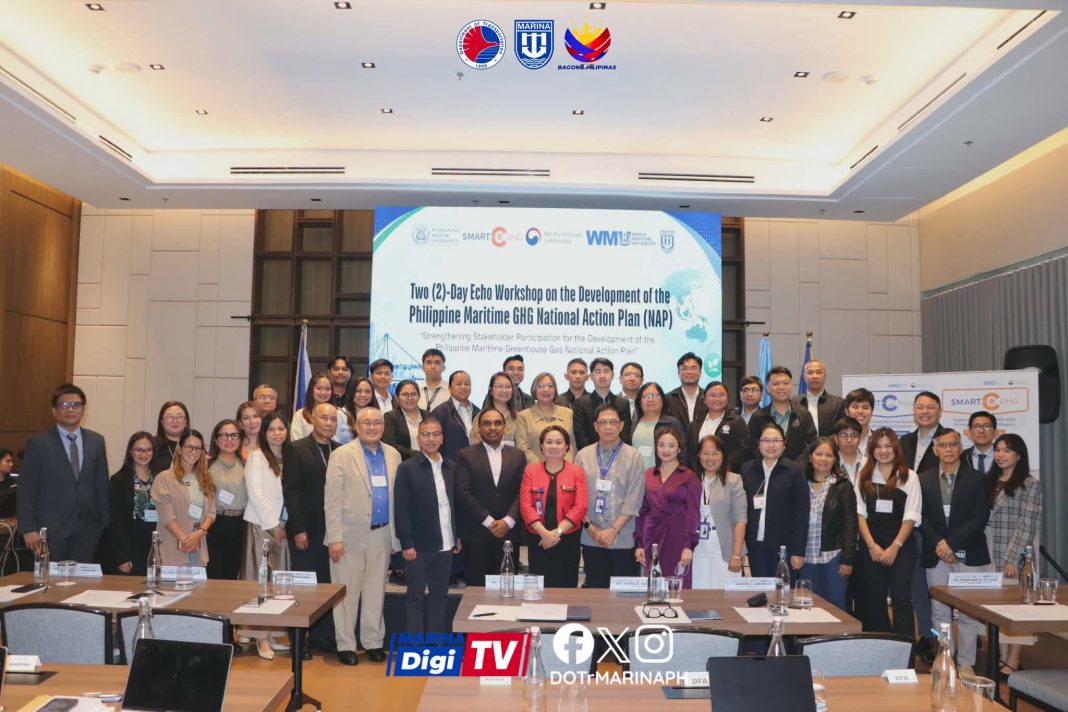
In line with efforts to promote marine environment protection particularly in reduction of greenhouse gas (GHG) emissions, various government agencies and relevant private maritime stakeholders gathered in the echo workshop held on 15-16 June 2026 to develop the Philippine National Action Plan for the Reduction of GHG Emission in the Maritime Industry (NAP-GHG).
The Maritime Industry Authority (MARINA) in collaboration with the International Maritime Organization (IMO), the Ministry of Oceans and Fisheries of the Republic of Korea and the World Maritime University (WMU) hosted the two-day activity aimed to gather stakeholders’ inputs, validate baseline information, identify gaps and challenges, and to generate recommendations in formulating the said action plan.
MARINA Administrator Sonia Malaluan believes that the echo workshop will provide a common understanding on the objectives of the SMART-C GHG Project, and the critical role of the whole-of-nation approach in the crafting of the NAP. Administrator Malaluan emphasized that the project is considered as an avenue to reaffirm the shared commitment to advancing safer, more efficient, and more sustainable maritime operations. She also recognized the expertise of both government and private sector who will serve as members of the National Task Force.
“When our environment calls for protection, we answer as one single community,” Malaluan said.
In her recorded speech, IMO Project Manager for SMART-C GHG Yingming Wang highlighted that the global maritime decarbonization agenda is now entering a critical phase following the adoption of the 2023 IMO GHG strategy. She added that Philippines’ actions can make an important impact not only to the national sustainable objectives but also to the aforementioned “global maritime decarbonization agenda.”
“The SMART-C GHG Project support to the development of the Philippine Maritime National Action Plan is timely and strategic” Wang said.
Meanwhile, the National Task Force for the SMART-C GHG Project in the Philippines will be responsible for the development, finalization, adoption and effective implementation of NAP-GHG.

