


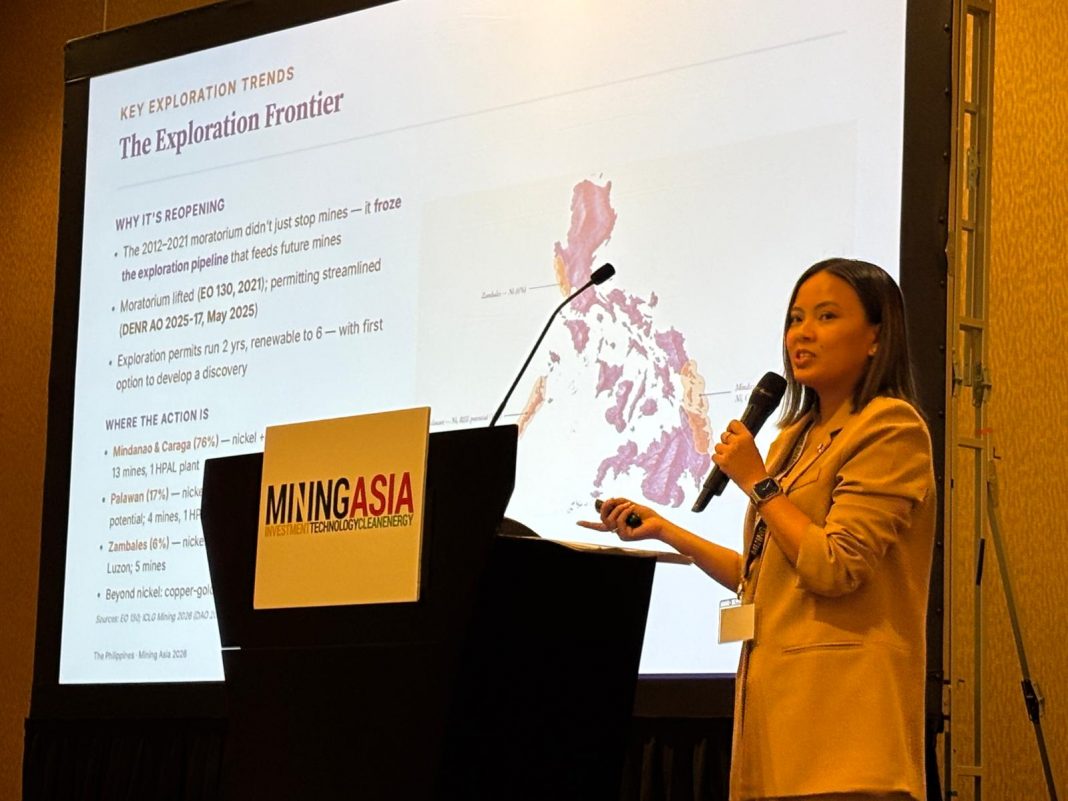
SINGAPORE—The Department of Trade and Industry (DTI), through the Philippine Trade and Investment Center in Singapore (PTIC-Singapore) and the Board of Investments (BOI), showcased the country’s critical minerals investment landscape, flagship projects, and fiscal incentives to a global audience at the Mining Asia conference, held in Singapore from June 23 to 24. The Philippines also hosted an exhibition booth throughout the two-day event, drawing strong investor interest.
Speaking to an international audience on June 23, 2026, PTIC-Singapore Commercial Counselor Atty. Carla Grepo made the case for the Philippines as a premier critical minerals destination. She highlighted the country’s top-five global resource base, which remains largely unexplored, alongside a mining sector reopening after nearly a decade of frozen investment and newly finalized fiscal rules that took effect this year. Grepo emphasized that the greatest opportunities lie not only in raw ore extraction but also in building local processing capacity and attracting long-term capital, technology, and supply partners.
“Demand for critical minerals is surging, and buyers, financiers, and governments are all actively trying to diversify away from single-source dependence. The Philippines sits right in the middle of that conversation—a top-tier endowment, barely touched, just as the world goes looking for new partners,” Grepo said.
She highlighted a pipeline of flagship copper-gold projects at advanced stages of development. These include Silangan in Surigao del Norte, which is set to begin commercial operations in early 2026; King-king in Davao de Oro, which progressed to a definitive feasibility study following an updated report in 2025; and Tampakan in South Cotabato, one of the largest undeveloped copper-gold deposits in the world.
Grepo also joined a panel discussion titled “Money Drives Minerals-Facilitating Strategic Mining Initiatives and Investments,” where she addressed how geopolitical rivalries are reshaping global supply chains. She noted that supply security, rather than just the lowest cost, has become the primary concern for buyers and investors, creating a major opening for the Philippines.
“Geopolitics has made mineral supply less about lowest cost and more about security of supply,” Grepo said. “Buyers and investors are not only looking for another source of ore. They want a reliable partner, clearer rules, traceability, and confidence that projects can move. That is where the Philippines has to compete.”
When asked which international partners the country is courting, Grepo emphasized an open, merit-based approach. “The best partners are not only financial investors. We are looking for companies that can bring technology, processing capability, market access, and long-term discipline around environmental and community obligations,” she said.
BOI Acting Director for the Resource-Based Industries Service Francis M. Peñaflor, further explained that green metals—including critical minerals—have been designated as a national priority sector. Under this strategy, the government aims to develop opportunities across the entire minerals value chain and connect them to key strategic industries, guided by what the BOI calls the “4Ps”: policy, permitting, partnership, and projects.
“We are placing particular emphasis on this sector because of its strong linkages to the country’s broader industrial development objectives,” Peñaflor said. “Critical minerals serve as essential inputs to a wide range of strategic industries, including renewable energy, electric vehicle components and batteries, semiconductors and electronics, digital infrastructure, and advanced manufacturing.”
To address policy and permitting, Peñaflor highlighted the “Green Lane for Strategic Investments,” a government mechanism that fast-tracks permits, licenses, and other regulatory requirements for high-impact priority projects. He also outlined the fiscal incentives available to qualified critical minerals ventures, including income tax holidays, enhanced deductions, and duty and VAT exemptions on imported capital equipment. For massive strategic projects involving at least 50 billion pesos (approximately 880 million dollars) in investment or generating 10,000 direct jobs, the government can extend income tax-based incentives for up to 40 years.
The Philippines remains one of the most mineral-rich nations in the world, ranking within the global top five for nickel, copper, and cobalt reserves. It was the second-largest producer of mined nickel in 2024, accounting for an estimated 9% to 10% of the global supply, trailing only Indonesia. In the first half of 2025, the country’s metallic production rose roughly 22% year-on-year, driven largely by higher gold prices.
The Mining Asia Conference provides a platform for global thought leaders, CEOs, government ministers, and industry experts to address the biggest challenges and help shape the future of the region’s mining sector. The event brought together delegates from over 30 countries.

