


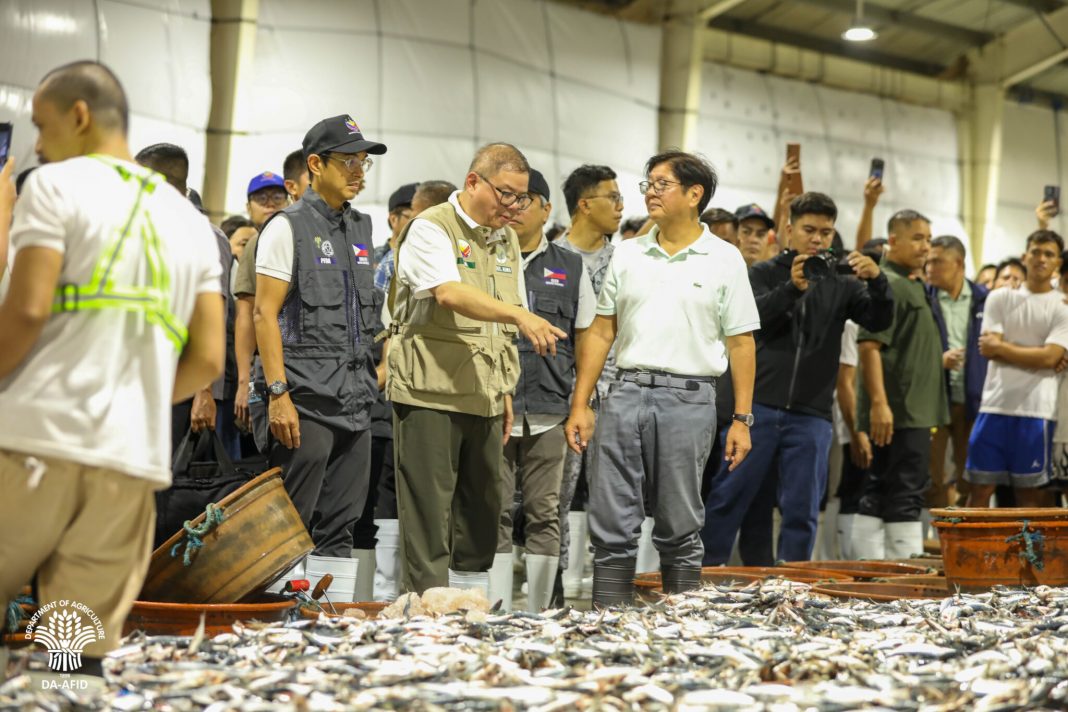
President Ferdinand R. Marcos Jr. on Saturday (July 11, 2026) led the audit of the ongoing rehabilitation of the PFDA-Navotas Fish Port Complex, highlighting the administration’s drive to modernize the country’s fisheries infrastructure to strengthen food security, improve supply chains, and reduce post-harvest losses.
Joining President Marcos were Agriculture Secretary Francisco P. Tiu Laurel Jr. , Agriculture Undersecretary Drusila Bayate and Philippine Fisheries Development Authority Acting General Manager Atty. Glen A. Pangapalan, Navotas Mayor John Rey Tiangco who toured the country’s premier fish port and presented the government’s modernization program aimed at further enhancing the nearly five-decade-old complex into a more efficient, resilient, and globally competitive fisheries hub.
Operated by the PFDA, the NFPC has been the country’s principal fish trading and distribution center since 1976. Recognized as one of the largest fish ports in Southeast Asia, it serves as the primary gateway for seafood supplied to Metro Manila and much of Luzon, making it one of the country’s most vital food logistics hubs.
The rehabilitation program marks another significant step in the continuing modernization of the fish port. The improvement of the PFDA-NFPC Shipyard – Phase 1 is scheduled for completion by December 2026. Meanwhile, the Phase 2 rehabilitation of Market Halls 1 and 2 is targeted for completion in June 2027.
Collectively, the ongoing rehabilitation and improvement projects will expand the fish port’s operational area by nearly 25 hectares, further improving its capacity to support the country’s fisheries industry.
“The future of Philippine fisheries will not be defined solely by how much fish we catch, but by how much fish we save after every catch,” Tiu Laurel said. “Every investment in modern ports, cold storage and post-harvest facilities reduces waste, raises fishermen’s incomes, improves food quality and strengthens our country’s food security.”
He added that modern fish ports are no longer simply landing sites but strategic economic infrastructure that lowers logistics costs, preserves product quality and creates more value across the fisheries supply chain.
Pangapalan said the Navotas Fish Port Complex directly benefits at least 30,000 people, with the number rising to around 50,000 during peak fishing season. Beyond those whose livelihoods depend directly on the complex, millions of consumers rely on it every day for a steady supply of seafood.
“For nearly five decades, the Navotas Fish Port Complex has served as the lifeline of the country’s fisheries trade, ensuring that fresh seafood reaches the tables of millions of Filipino families,” Pangapalan said. “Through this modernization, we are strengthening that legacy by building a more efficient, resilient, and future-ready fish port that supports our fisherfolk, creates more livelihood opportunities, and reinforces the nation’s food security.”
Beyond upgrading concrete structures and port facilities, the PFDA-NFPC modernization reflects a broader shift in agricultural policy that recognizes efficient logistics and post-harvest systems as essential pillars of food security.
As the government continues to stabilize food prices and strengthen the fisheries sector, sustained investments in modern infrastructure, efficient logistics, and post-harvest systems are helping build a more resilient fisheries industry and reinforce the country’s long-term food security.

