


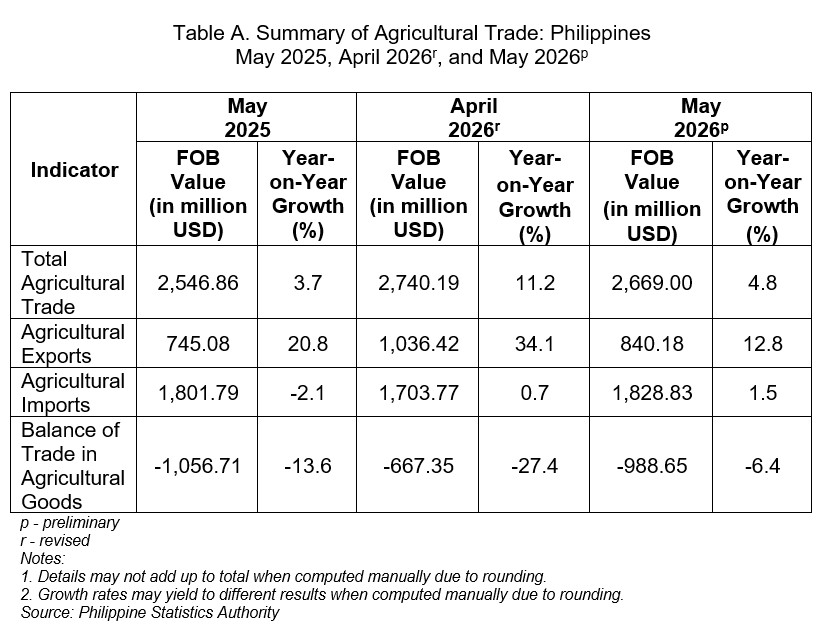
The country’s total agricultural trade reached USD 2.67 billion in May 2026, marking a 4.8% increase compared to the same period last year, according to the latest data released by the Philippine Statistics Authority (PSA).
While trade expanded on an annual basis, the May figure represents a cooling period from earlier in the year, tracking as the lowest overall agricultural trade value recorded since February 2026 (USD 2.46 billion).
Agricultural trade in the Philippines remains heavily import-dependent, with imports making up more than two-thirds of all inbound and outbound economic activity.
| Trade Component | Value (USD) | Share of Total Trade | Annual Change |
| Total Trade | $2.67 Billion | 100% | +4.8% |
| Agricultural Imports | $1.83 Billion | 68.5% | — |
| Agricultural Exports | $840.18 Million | 31.5% | +12.8% |
| Trade Deficit | -$988.65 Million | — | -6.4% (Decrement) |
The agricultural trade deficit stands at USD -988.65 million. While this is a 6.4% improvement (decrease in deficit) compared to May 2025, it marks the widest gap between imports and exports seen since March 2026, when the deficit hit USD -1.25 billion.
Philippine agricultural export revenues saw a strong annual boost, climbing 12.8% to USD 840.18 million compared to USD 745.08 million in May 2025. This agricultural surge accounted for 10.7% of the country’s total export revenue across all sectors for the month.
-
The Top 10 Powerhouses: The top 10 agricultural commodity groups collectively generated USD 815.03 million, commanding a massive 97.0% share of total agricultural export revenue. This combined group enjoyed a 12.3% annual growth rate.
-
Fruits and Nuts in the Lead: Edible fruits, nuts, and citrus/melon peels remained the country’s primary agricultural export. Valued at USD 299.68 million, this single category commanded 35.7% of all agricultural exports in May.
Agricultural exports to neighboring ASEAN member countries reached USD 76.45 million during the month, representing 6.5% of the Philippines’ total export value to the region.
Among ASEAN nations, Malaysia stood out as the top buyer, purchasing USD 27.90 million worth of Filipino agricultural goods—a dominant 36.5% share of the total agricultural exports bound for ASEAN markets.

