


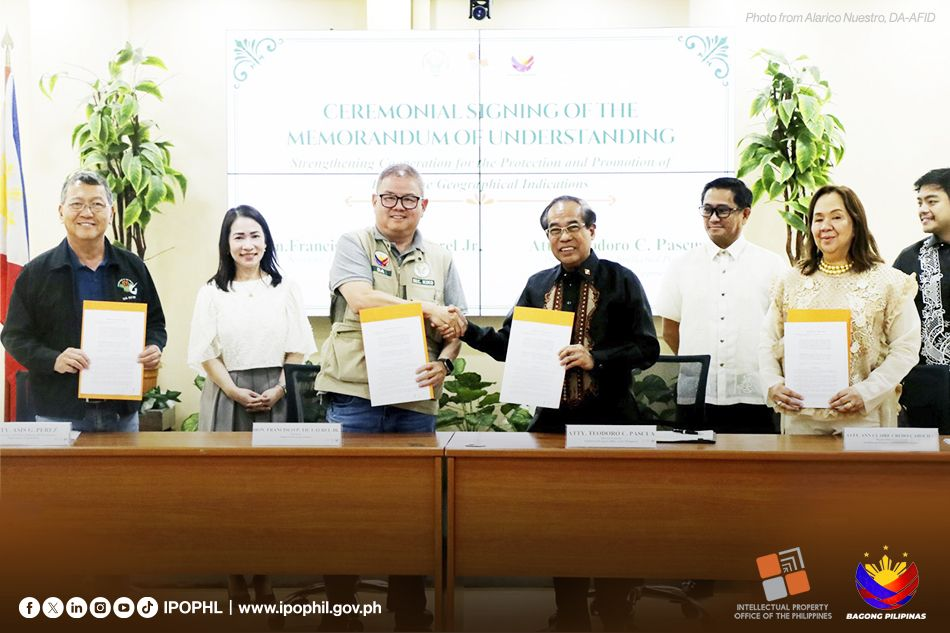
The Intellectual Property Office of the Philippines (IPOPHL) and the Department of Agriculture (DA) have strengthened their partnership to accelerate efforts to help more Philippine agricultural and fishery products gain global recognition and command premium market value through geographical indication (GI) protection.
The Memorandum of Understanding (MOU) renews and expands the agencies’ collaboration first formalized in 2018, combining IPOPHL’s expertise in intellectual property (IP) with the DA’s technical leadership in agriculture to fast-track the identification, protection and commercialization of products whose distinct qualities are rooted in their place of origin.
The initiative builds on the success of Philippine GIs such as Guimaras Mangoes and Alburquerque’s Asin Tibuok, while paving the way for more local agricultural products to secure legal protection and stronger market positioning both locally and internationally.
“This partnership gives structure to the work that IPOPHL and the DA have already begun, from identifying potential GI products and aligning technical assistance for producer groups to ensuring that GI registration translates into real market value rather than remaining just a certificate,” said IPOPHL Director General Teodoro C. Pascua.
Agriculture Secretary Francisco P. Tiu Laurel Jr. said the partnership will help fast-track the country’s GI development efforts and ensure that the Philippines secures protection for its unique products before others capitalize on them.
“These products reflect the richness of our biodiversity, traditions and craftsmanship. They deserve recognition not only in the Philippines but also in the global marketplace,” Sec. Tiu Laurel said.
To date, IPOPHL and the DA have identified at least 30 agricultural and fishery products with strong GI potential. Among these are the Cordillera Heirloom Rice, Quezon Lambanog, Oriental Mindoro Calamansi, Camarines Norte Queen Pineapple, Nueva Vizcaya Dalandan, Davao Pomelo, Davao Saba Banana, Bonuan Bangus, Zambales Mangoes and Davao Cacao.
Under the agreement, IPOPHL and the DA will jointly strengthen the development and protection of GI products through closer technical collaboration, certification support and capacity-building for producer groups and stakeholders.
IPOPHL will provide training on the legal and commercial value of GIs and provide technical guidance on certification systems, quality control and intellectual property management.
The DA, meanwhile, will identify products with origin-linked qualities, conduct the technical validation required for GI registration, establish product certification mechanisms and strengthen producer organizations to ensure that registered GIs consistently meet quality standards and deliver greater economic benefits to local communities.
To promote innovation, commercialization and stronger IP management, the agencies will also work with partner institutions such as IPOPHL’s network of over 100 Innovation and Technology Support Offices (ITSOs) which are mainly located in state universities and colleges and research institutions throughout the country.
The renewed partnership also complements the broader collaboration between the Department of Trade and Industry (DTI) and IPOPHL to help MSMEs move beyond production and into value creation, with brands capable of competing in both domestic and international markets.

