


The Philippines, as this year’s chair of the Association of Southeast Asian Nations (ASEAN), should lead efforts to mobilize climate finance, technology and partnerships while making climate resilience part of the region’s security agenda.
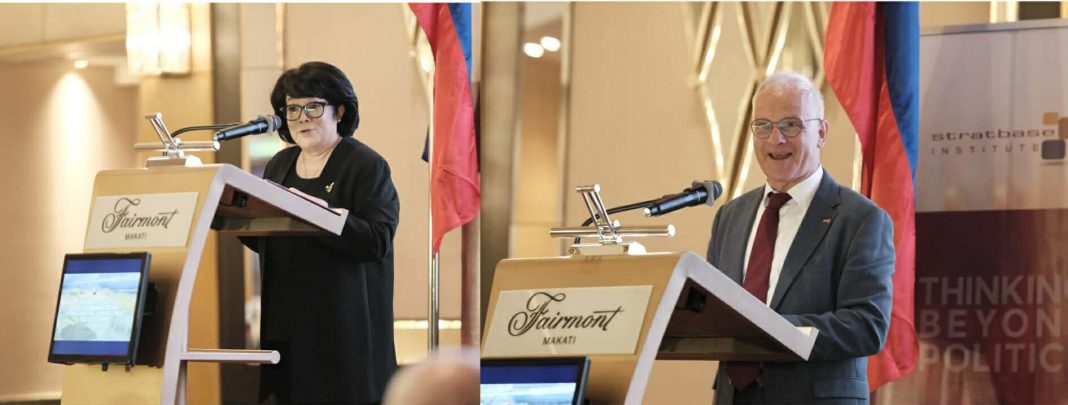
This was according to the country’s top environmental officials who spoke at a forum on climate security organized by the Stratbase Group and the German Embassy on Monday.
Led by Environment Secretary Juan Miguel Cuna and Special Envoy for Disaster Risk Reduction and Management Antonia Yulo-Loyzaga, the experts agreed that the country’s ASEAN chairmanship presented an opportunity to push for a more integrated approach to climate security, linking environmental resilience with the bloc’s political, economic and security priorities.
“The region should speak with greater coherence in mobilizing the finance, technology, and partnerships needed for a just transition,” Cuna said. “Climate resilience must increasingly become part of our ASEAN’s regional security architecture.”
He stressed that the Philippines needed access to climate finance, appropriate technology, science and data, as well as partnerships aimed at strengthening institutions and communities over the long term.
“No ASEAN member state can address these challenges entirely on its own,” Cuna said.
It’s a call echoed by Stratbase Group President Victor Andres Manhit, who stressed that strategic partnerships and alignment “will remain essential to strengthening climate security and resilience,” he said.
“For the Philippines, and for all ASEAN member-states, it is therefore crucial that we harness strategic partnerships with like-minded countries,” Manhit said. “Our individual and collective ability to withstand these pressures will ultimately depend on how effectively we work across sectors and borders, and how strategically we build and sustain meaningful partnerships.”
Both Cuna and Manhit also called for greater participation from the private sector, civil society and academe in advancing renewable energy, resilient infrastructure, climate-smart production and nature-positive investments.
Yulo-Loyzaga echoed this sentiment, saying the Philippines, as ASEAN chair, had a “unique opportunity” to lead the region toward recognizing climate change as part of its security architecture, she said.
ASEAN’s stability, prosperity and security would depend on how its members adapt to climate risks and on their commitment to science-informed cooperation with like-minded countries within a rules-based international order, she added.
The Philippines, she noted, had already incorporated climate security into its national development and security frameworks, with the National Security Strategy 2023-2028 identifying climate change as a threat multiplier and security concern.
She also cited the country’s shift toward more anticipatory disaster response, including the 2025 Declaration of Imminent Disaster Law, which provides local governments with more immediate access to resources to prepare for incoming hydrometeorological hazards.
Yulo-Loyzaga said the country’s National Adaptation Plan estimated the cost of inaction during the current decade at between P1.2 trillion and P1.4 trillion.
At the regional level, she said existing ASEAN mechanisms on disaster response, climate change, food security, biodiversity and maritime cooperation needed to be better connected, as climate risks cut across these areas.
For his part, German Ambassador to the Philippines Andreas Pfaffernoschke also stressed the importance of stronger regional cooperation and urged the ASEAN member-nations to strengthen regional early warning systems that combine climate science with conflict-sensitive analysis.
At the same time, he called for climate adaptation projects that are designed with conflict prevention in mind and for vulnerable communities – including farmers, fishers, Indigenous peoples, women and young people – to have a greater role in policymaking.
Likewise, Pfaffernoschke said ASEAN should also strengthen cooperation on shared resources, including transboundary water, marine resources and food systems, while improving coordination on disaster response and climate-related displacement.
Climate finance, he said, should likewise be connected with peace-building efforts.
“A community affected by conflict and climate change should not have to choose between humanitarian assistance, peace-building and adaptation,” Pfaffernoschke said.

