


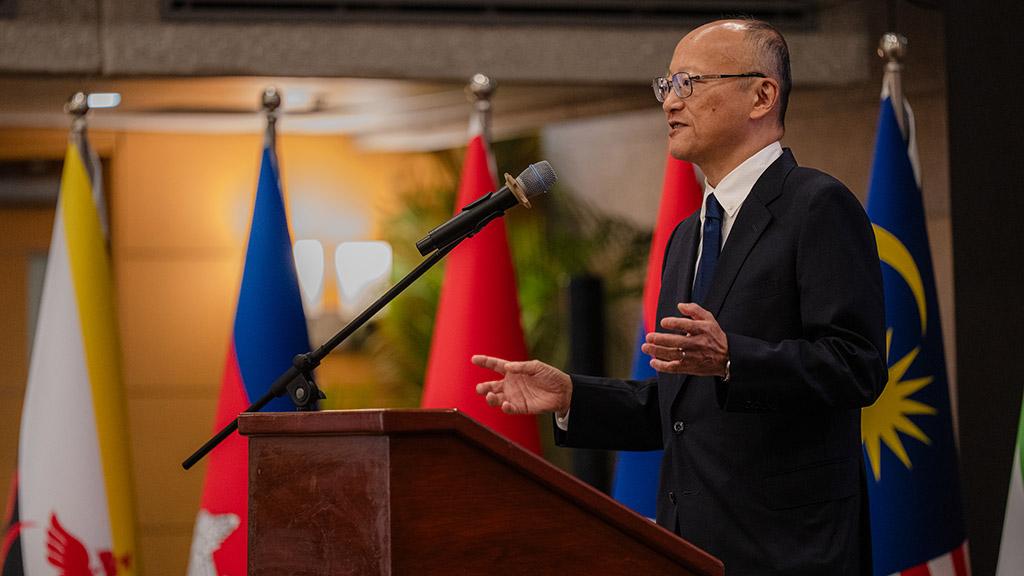
Asian Development Bank (ADB) President Masato Kanda announced that the bank plans to mobilize up to $30 billion by 2030 to support Southeast Asia’s infrastructure priorities. The announcement was made during the Association of Southeast Asian Nations (ASEAN) High-Level Conference on Connectivity, held on August 26, 2026.
During a gathering attended by Foreign Affairs Secretary Ma. Theresa P. Lazaro and Economy, Planning, and Development Secretary Arsenio M. Balisacan, Kanda stressed that ASEAN needs at least $210 billion annually in infrastructure investment. He said this funding is crucial to sustain economic momentum and enhance resilience against future global shocks.
The funding commitment, originally announced at the ASEAN Summit in May, includes financing from both public and private sectors, support for project preparation, and mechanisms for cross-border coordination. ADB has positioned itself as ASEAN’s primary bank, pledging to act as the region’s strategic financing partner and a platform for mobilizing long-term development finance.
Kanda highlighted the ASEAN Power Grid as central to the financing strategy, with ADB planning to commit up to $10 billion through 2035 to help construct the region’s cross-border electricity transmission network. The bank identified three priority areas for its engagement: dedicated financing for public and private sector operations aligned with ASEAN priorities, upstream project preparation to build robust investment pipelines, and close coordination to support implementation across national borders.
The conference convened ambassadors, policymakers, and regional development partners to address shared bottlenecks to infrastructure connectivity. Participants identified constrained fiscal space in several member states, a limited pipeline of bankable regional projects, and fragmented financing arrangements across institutions and borders as primary obstacles to progress.
“This is exactly where ADB can add value,” Kanda stated during his address. “The next phase of ASEAN integration will be built through projects that connect your economies, strengthen your resilience, and create opportunity across borders.”
Kanda also said ADB will advance initiatives under the Philippines’ chairship, including scaling up support for the new ASEAN Digital Economy Framework Agreement, and efforts on the blue economy and resilient rivers and food systems.
The ADB official highlighted that the connectivity challenges in Southeast Asia are becoming increasingly urgent as the region works on post-pandemic recovery and adapts to changing global supply chain dynamics. Kanda emphasized that cross-border infrastructure is critical for the efficient movement of goods, energy, capital, data, and people, which are essential for prosperity that no individual country can achieve on its own.
Philippine officials who opened the conference underscored the host nation’s institutional capacity to convene ASEAN stakeholders. Balisacan, who heads the country’s economic planning agency, has previously advocated for stronger regional trade and investment frameworks as the Philippines seeks to deepen its economic ties with neighboring economies.
The Philippines will hold the ASEAN chairship until December 2026, focusing on connectivity and resilience as key priorities.

