


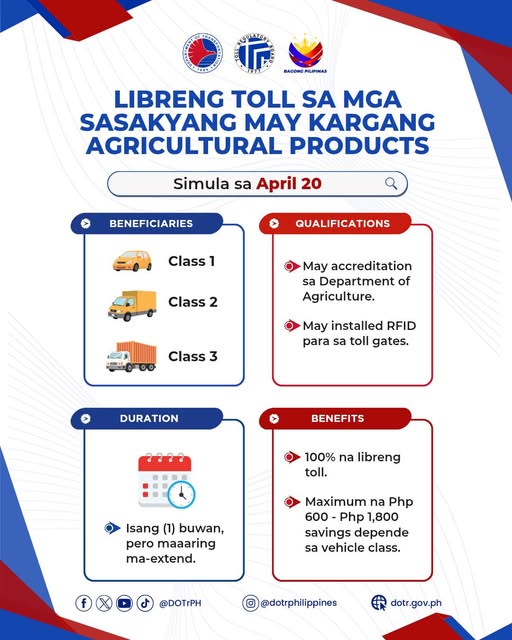
In a decisive move to combat rising food costs, President Ferdinand Marcos Jr. has directed the implementation of a toll-free policy for vehicles transporting food and agricultural products across all major expressways, effective April 20, 2026.
The directive aims to mitigate the impact of the ongoing global oil crisis on the local supply chain. Transportation Secretary Giovanni Lopez announced that the Toll Regulatory Board (TRB) and the Department of Agriculture (DA) have reached an agreement with major toll concessionaires to provide immediate relief to farmers, truckers, and industry stakeholders.
“Ang utos sa atin ng Pangulo, dapat tuloy-tuloy ang pag-transport ng pagkain para matiyak na stable ang presyo ng pangunahing pagkain para masiguro na abot-kaya pa rin ito para sa ating mga kababayan,” said Secretary Lopez.
To ensure an organized rollout, the following guidelines have been established:
-
Eligibility: Only vehicles accredited by the Department of Agriculture (DA) and equipped with a functional RFID sticker are eligible for the exemption.
-
Rebate System: Truckers stand to save between ₱600 and ₱1,800 per trip, depending on vehicle class. These savings will be credited back to their RFID accounts on a weekly basis.
-
Duration: The initiative will run for an initial period of one (1) month, with the possibility of an extension pending a joint review by the DA, DOTr, TRB, and private operators.
Secretary Lopez expressed gratitude to the leadership of the country’s primary toll operators—San Miguel Corporation (SMC) led by Mr. Ramon S. Ang, and Metro Pacific Tollways Corporation (MPTC) led by Mr. Manny V. Pangilinan—for their cooperation in protecting the agricultural sector.
The toll relief complements recent efforts by the Philippine Ports Authority (PPA), which has already slashed roll-on/roll-off (RoRo) fees to just ₱1 for vehicles carrying raw and unprocessed agricultural goods. Together, these measures create a “green lane” across land and sea to ensure food supply chain reliability.
The government continues to monitor market conditions to ensure that the logistics savings are directly reflected in the retail prices of goods, providing much-needed breathing room for Filipino consumers.

