


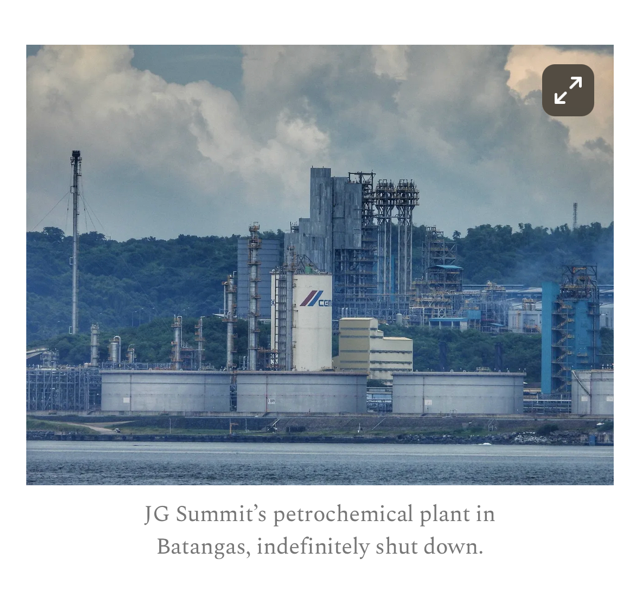
Economist Joey Sarte Salceda has urged the government’s sovereign fund Maharlika Investment Fund (MIF) to take a minority stake in the Gokongwei-owned JG Summit Olefins Corp. (JGSOC) and develop an incentive scheme beyond the standard CREATE MORE menu to keep the USD2 billion manufacturing complex—currently undergoing a sale process—operating on Philippine soil.
In a post on his Substack account, the former legislator said the MIF was built exactly for long-horizon strategic assets. “Maharlika could take a minority stake,” he urged.
On top of MIF participation, he said a foreign partner with expertise in olefins could provide the technology, while a group of local industrial players could cover the remaining funding requirement.
On incentives, the former Albay legislator noted that JG Summit, the parent company of JGSOC, booked a PHP114.3-billion impairment on JGSOC in 2025, and any serious acquisition and restart will easily exceed USD1 billion.
He said a project of that scale qualifies as “highly desirable” under Section 301 of the National Internal Revenue Code. The DOJ affirmed in July 2025 that the President has the authority to grant fiscal and non-fiscal incentives to such projects independently of the Fiscal Incentives Review Board. That means that, beyond the standard CREATE MORE menu, the President can extend power rate discounts, water access, substation construction, and other infrastructure support that no ordinary Board of Investments or Philippine Economic Zone Authority package can match.
He cited the possibility of granting the Batangas petrochemical complex globally competitive power, with a customized availment period and a full Section 301 package, as something a foreign partner will respond to positively.
He added that Finance Secretary Frederick Go can help structure a package that places the asset in the right hands, without any lingering family stake to worry about.
Industrialization
Sarte Salceda emphasized that the Bataan petrochemical complex was one of the Ten Major Industrial Projects envisioned by Minister Roberto Ongpin in the 1980s. It was meant to anchor a full Philippine polymers industry, providing domestic ethylene, propylene, and downstream plastics that every manufacturing economy in the region now takes for granted. Like most of the Ten Major Industrial Projects, it did not push through. The debt crisis, the political transition of 1986, and the decades of import liberalization that followed derailed it.
In January 2025, JGSOC placed its Batangas petrochemical complex—a PHP150-billion facility with over 1 million metric tons per year of capacity—on indefinite commercial shutdown. In March this year, JG Summit appointed International Process Plants to lead a global sale process. Among the pathways explicitly on the table is the acquisition and relocation of the plant to another region.
“That is the part that should alarm us. A petrochemical complex of this scale, built on Philippine soil with Philippine permits and Philippine community relationships, could be dismantled and shipped abroad while the country that needs it most loses the chance to own it,” he said.
JGSOC failed commercially because of the global petrochemical glut, driven by massive new capacity in the Middle East and the United States, where feedstock is cheap and scale is enormous.
But he argued that a Filipino conglomerate operating alone could not compete, hence the need to change the model to ensure the asset does not leave the country.
“The Batangas complex, while it is still here, deserves to be treated as a national industrial program,” he pointed out.
A working petrochemical complex stores large volumes of crude, naphtha, and intermediate feedstocks at any given time. It is not a Strategic Petroleum Reserve in the formal sense, but it provides a meaningful operating buffer—under Filipino control—for inputs that would otherwise be fully imported during a crisis.
Fertilizer
Petrochemical plants play a critical role in producing synthetic fertilizers, using derivatives from oil and natural gas—specifically hydrogen and nitrogen—to create nitrogen-based fertilizers, with urea being one of the most common products.
Citing data, Sarte Salceda pointed out that between end-February and late March 2026, global urea prices rose roughly 50 percent, from about USD482 per ton to USD720. Diammonium phosphate crossed USD700 per ton. The Persian Gulf accounts for 30 to 35 percent of global urea exports and roughly a third of internationally traded fertilizer by sea. When Hormuz closes, that supply does not reroute—it stops.
The Philippines imports over 2.5 million metric tons of fertilizer a year, worth close to a billion dollars. Thus, he said he had earlier urged Agriculture Secretary Francisco Tiu Laurel to prepare for the September trough. “That is when the fertilizer prices our farmers are being quoted today, for the nearest wet-season planting, will show up as lower rice output on the ground. A fertilizer shock in April becomes a rice shock in September,” he warned.
The same applies to plastics. The hydrocarbon molecule remains the cheapest and most versatile feedstock for polymers used in packaging, pipes, medical supplies, electronics, and construction materials. “We have no current substitute at scale, and we import nearly all of the intermediate feedstock,” he said.
Sarte Salceda recalled that the Philippines spent decades debating whether it should be an industrial country.
The fuel and fertilizer crises of 2026 have settled that debate, he said. “The countries that make their own fertilizer, their own plastics, and their own steel are the countries that weather shocks. The countries that import all three are the countries that absorb them. We cannot fully decouple from the global economy, and we should not try. But the inputs that determine whether our farms produce, our factories run, and our hospitals function should be inputs we can make ourselves, or at least buffer ourselves against losing. The Batangas complex is still on Philippine soil. Let us keep it there, and, with a helpful state, run it,” he concluded.

