


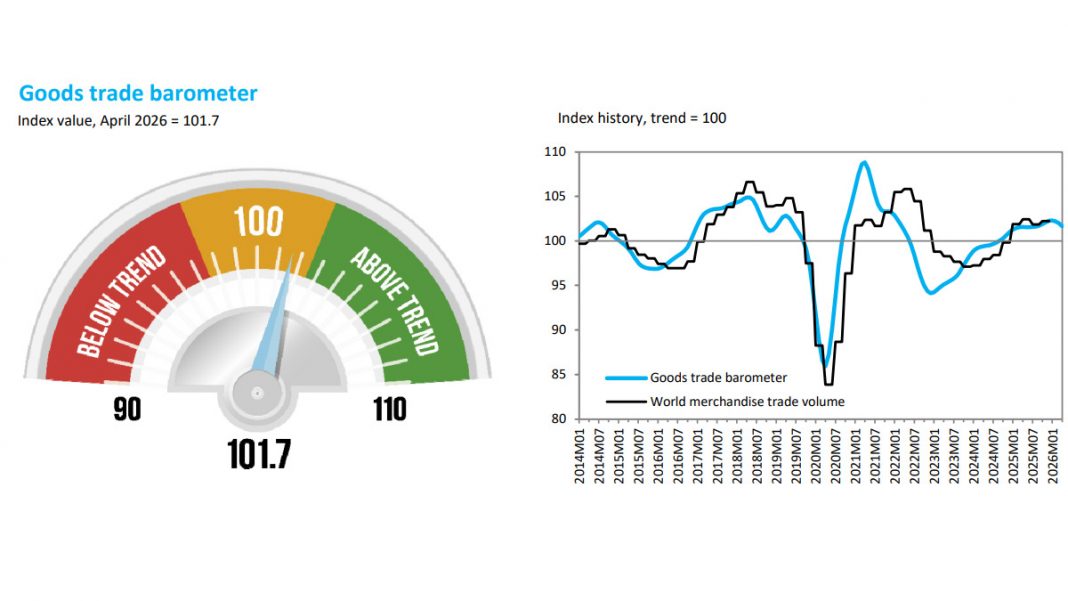
Global merchandise trade remained highly resilient through the first half of 2026, defying significant geopolitical headwinds, according to the latest World Trade Organization (WTO) Goods Trade Barometer.
The barometer’s current headline reading stands at 101.7. While this represents a slight deceleration from January’s reading of 102.3, any score above the baseline value of 100 indicates that world merchandise trade continues to track above its medium-term trend. This momentum extends a period of above-trend growth that actual quarterly trade volumes have maintained since the beginning of 2025.
The WTO data reveals a stark balancing act currently shaping the global economy. Ongoing conflict in the Middle East continues to exert downward pressure on global shipping and trade. However, these disruptions are being actively offset by a massive surge in global demand for electronic components—a direct result of sustained corporate and state investments in artificial intelligence (AI).
“The latest reading shows signs of genuine resilience,” the report notes. “While we see indications that merchandise trade growth may be starting to slow from its peak, the broader picture points to relatively stable global trade growth despite localized friction.”
The strength of the current trade trajectory is heavily concentrated in technology manufacturing, while industrial and consumer sectors show signs of flattening:
-
Electronic Components (105.5): Standing firmly above trend, this index is the primary engine of current trade growth, driven by the global rush for AI-enabling hardware.
-
Shipping & Logistics: Both container shipping (102.4) and air freight (102.2) continue to signal expansion, though their growth rate has cooled compared to earlier in the year.
-
Export Orders (100.5): This highly predictive index remains slightly above trend, suggesting steady demand in the immediate pipeline.
-
Automotive Products (99.8) & Agricultural Raw Materials (98.9): Both indices have dipped slightly below the baseline trend, signaling a mild softening in consumer manufacturing and agricultural trade.
The current data aligns closely with the WTO Secretariat’s Global Trade Outlook and Statistics (GTOS) report issued on March 19. That report outlined three distinct pathways for 2026 trade growth:
| Scenario | Predicted 2026 Merchandise Growth |
| Baseline Scenario | 1.9% |
| High Energy Price Scenario (Reflecting Middle East Escalation) | 1.4% |
| AI-Infused Upside (Sustained technology investment) | Adds up to 0.5 percentage points to either scenario |
This resilience follows a volatile 2025 sequence. In early 2025, global trade volumes spiked sharply as international importers front-loaded purchases to get ahead of anticipated tariff hikes. While growth normalized later in the year, the structural demand for AI infrastructure kept final 2025 numbers stronger than initially projected.
The WTO will provide its next comprehensive global trade forecast update in October 2026.

