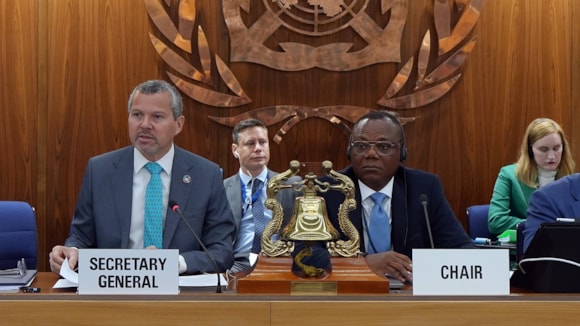
Opening the 84th session of the Marine Environment Protection Committee (MEPC 84) on Monday, International Maritime Organization (IMO) Secretary-General Arsenio Dominguez called on Member States to bridge differences and accelerate the development of the IMO Net-Zero Framework.
Against a backdrop of geopolitical tension and urgent climate targets, Mr. Dominguez emphasized that the maritime industry must serve as a global example of cooperation.
“At a time when there is already enough disagreement around the world, I ask you that we can set an example of effective multilateralism,” Mr. Dominguez stated. “Let us move forward where we agree and continue to elaborate where further work and understanding is required.”
The central focus of MEPC 84 is the refinement of mid-term measures to slash greenhouse gas (GHG) emissions. The Secretary-General highlighted significant progress in the following areas:
-
Technical Regulations: Advancements in Greenhouse Gas Fuel Intensity (GFI) guidelines and life-cycle assessments provide a foundation for globally harmonized reporting.
-
Economic Measures: Continued dialogue on creating a “just and equitable transition” to ensure no state is left behind in the shift to green fuels.
-
Proven Progress: Data submitted to the session reveals that shipping’s carbon intensity has already dropped by more than 38% since 2008, proving that efficiency measures are delivering tangible results.
The Committee will also evaluate emerging technologies, including onboard carbon capture, wind propulsion, and the monitoring of methane and nitrous oxide emissions.
Before addressing the environmental agenda, the Secretary-General expressed “grave concern” regarding the ongoing situation in the Strait of Hormuz. He noted that thousands of seafarers remain stranded, facing significant psychological strain and physical risk.
“Seafarers and shipping must never be used as collateral victims of any geopolitical conflict,” Dominguez remarked, reaffirming the IMO’s role as the primary venue for multilateral agreement on the safety of international navigation.
Beyond decarbonization, MEPC 84 is set to address several critical pillars of marine conservation:
-
Marine Plastic Litter: The Committee is expected to adopt the 2026 Strategy and Action Plan and consider a new mandatory code for the transport of plastic pellets in freight containers.
-
Ballast Water & Biofouling: Delegates will work on amendments to the BWM Convention and transition toward a standalone legally binding instrument for ships’ biofouling.
-
Underwater Noise: Discussions will continue on mitigating the impact of radiated noise from shipping on marine life.
The session, chaired by Dr. Harry Conway (Liberia) and Vice-Chaired by Mr. Hanqiang Tan (Singapore), will run throughout the week. The Secretary-General concluded by urging delegates to engage in “constructive and pragmatic exchanges” to ensure the shipping industry remains a leader in global environmental governance.