Driven by higher value products, Philippines’ exports in March surged to a historic high of USD8.17 billion or 20.4 percent higher from USD6.78 billion in the same month in 2025, marking the highest monthly performance on record since the Philippine Statistics Authority (PSA) International Merchandise Trade Statistics (IMTS) series began in 1991.
Based on preliminary PSA data, the March exports brought the first quarter tally to USD22.70 billion, up by 12.7 percent from USD 20.14 billion in the same period last year marking the 2nd highest quarter growth performance in more than four years since 2nd Quarter 2021.
Trade and Industry Secretary Cristina A. Roque attributed the growth to the government’s drive towards higher value products in key sectors, and targeted efforts to diversify markets.
Secretary Roque noted that the sterling export performance in March reflects sustained growth momentum in exports, supported by continued demand in key sectors, particularly electronics.
“March’s export performance demonstrates that the government’s drive towards higher value products in high-performing industries like electronics while expanding market opportunities with targeted and strategic trade and investment promotion initiatives are helping exporters adapt to evolving global conditions and translating to export gains,” Secretary Roque said.
The DTI continues to closely monitor global developments that may affect trade and logistics, including the ongoing conflict in the Middle East.
While exports have remained resilient, Secretary Roque said that the Department is assessing and addressing potential risks that may impact specific sectors and markets.
DTI is working with industry stakeholders to help exporters navigate possible disruptions through market diversification and pivoting to domestic and other export markets, supply chain adjustments, and the provision of timely market intelligence on viable alternative routes.
The DTI is also working closely with the SBCorporation on the rollout of the PHP3 billion Export Business Expansion Fund (EBEF) which will provide financial support to MSMEs affected by the ongoing Middle East Crisis. Under the EBEF, loans of up to PHP20 million may be secured and repaid for up to 5 years, with one year grace period, to secure export markets through business expansion, increasing production capacity and modernization activities to scale up and strengthen their competitiveness and compete globally.
Electronics
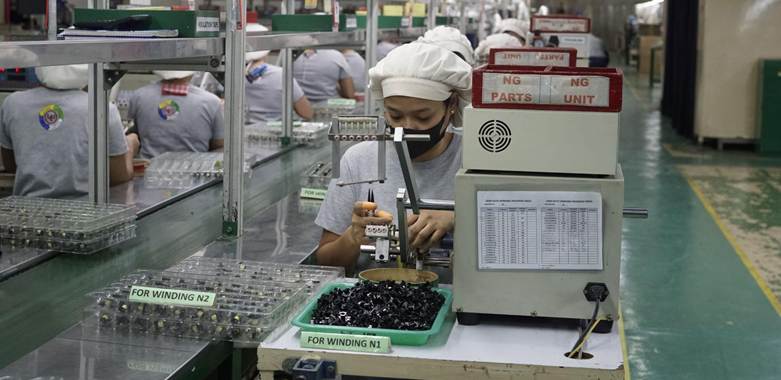
The increase in exports was mainly driven by electronic products, which recorded USD 4.82 billion and remained the country’s top export, accounting for 59.0 percent of total exports. This was followed by machinery and transport equipment at USD407.22 million, and other mineral products at USD401.81 million.
Industry sources noted that the strong performance of electronics continues to be supported by global demand for semiconductor components and devices used in emerging technologies such as artificial intelligence (AI), Internet of Things (IoT), and electric vehicles. This highlights the Philippines’ role in global electronics value chains, particularly in assembly, testing, and packaging services. Despite global trade uncertainties, including developments in the Middle East, the Semiconductor and Electronics Industries in the Philippines Foundation, Inc. projects the industry to grow by around 5% in 2026 and exceed USD 50 billion in exports.
Non-electronic exports posted mixed results, reflecting shifts in global demand across industries. Growth was supported by machinery and transport equipment, as well as mineral-based products and gold, driven by continued industrial activity and demand for raw materials. Meanwhile, some traditional export items such as other manufactured goods and coconut oil recorded declines, indicating softer demand in selected markets.
The United States remained the Philippines’ largest export destination, with exports reaching USD1.40 billion. Hong Kong followed at USD 1.30 billion, while exports to Japan reached USD 962.41 million. Shipments to these markets posted double digit growth rates including China which retained its spot as 4th largest market posting USD956.77 million in exports, while earnings from Taiwan recorded USD 393.14 million during the period.
In the agro-based sector, industry stakeholders reported generally stable demand across key markets, although performance in some products may be affected by supply-side and logistics constraints.
Processed fruits, particularly tropical varieties, continue to see steady demand despite raw material challenges affecting specific products such as calamansi, while coconut-based products remain supported by food manufacturing demand and growing global interest in plant-based and dairy-free alternatives, despite supply-side factors influencing coconut oil exports. Some exporters also reported declines in shipments to the Middle East, particularly for bananas, due to maritime shipping disruptions linked to ongoing geopolitical tensions in the region.