


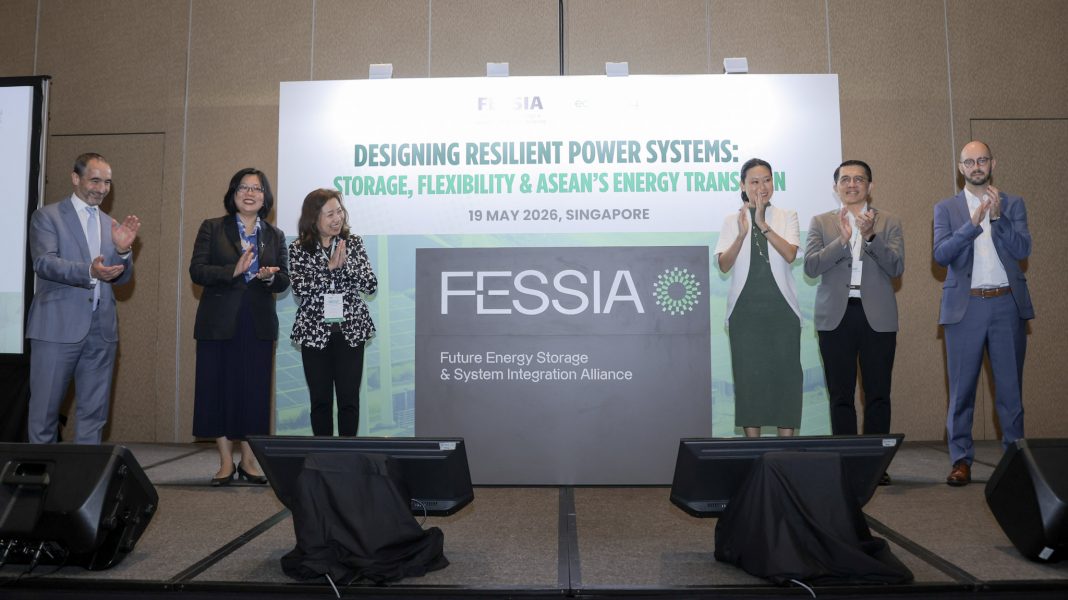
The Future Energy Storage & System Integration Alliance (FESSIA) officially launched and unveiled the findings of its inaugural report, “Unlocking the Role of Utility-scale Battery Energy Storage Systems (BESS) in ASEAN electricity markets,” during Temasek’s Ecosperity Week 2026.
Developed in collaboration with global energy expert DNV, the report is one of Southeast Asia’s first in-depth studies on utility-scale BESS deployment, charting how clearer policy frameworks, market mechanisms, and revenue models can enable the scaling and monetization of energy storage across the region.
As variable renewable energy (VRE) deployment rapidly accelerates across Southeast Asia, grid flexibility and storage have become critical to maintaining energy security.
However, ASEAN’s energy storage market remains heavily underdeveloped, with only about 1.4 GW currently operational. While global BESS technology costs have plummeted by nearly 90% over the past decade, the report highlights that ASEAN’s primary hurdle is no longer technology readiness, but market readiness.
“The energy transition is entering a new phase where flexibility must become central to power-system planning, operations, and market design,” said Liming Qiao, CEO and Founder of FESSIA. “The first phase focused on deploying renewable energy. The last 10% will depend entirely on whether power systems can integrate renewables reliably at scale. BESS should not be viewed simply as a power bank. Its real value lies in providing broader flexibility services, including ancillary services, energy shifting, renewable hybridization, and transmission and distribution deferral.”
Key Findings: High-Value Value Creation in the Philippines and Vietnam. Using the Philippines and Vietnam as core case studies, the report identifies immense, immediate economic opportunities for utility-scale storage:
-
The Philippines: BESS ancillary services could reduce overall power system costs by up to USD 275 million annually and unlock USD 2.25 billion in integrated Solar + BESS revenues by 2030.
-
Vietnam: Annual BESS investments are projected to grow exponentially from USD 750 million in 2026 to USD 5.7 billion by 2030.
-
Revenue Stacking: Enabling project developers to stack multiple revenue streams (e.g., combining ancillary services with energy shifting) is identified as the single most critical factor to improving project bankability and accelerating private deployment.
Dr. Matthew Rowe, Director, Power Grids Asia Pacific, DNV Energy Systems, commented: “Accelerating the transition requires electricity markets and regulatory frameworks to evolve. In both the Philippines and Vietnam, the highest-value use cases depend on clearer operational rules that properly recognize the fast-response and flexibility capabilities of BESS. DNV is pleased to support FESSIA in contributing insights to reduce investment risk and accelerate regional deployment.”
Unlike traditional industry alliances formed by established market players, FESSIA was uniquely founded to proactively build the regulatory and policy frameworks required for the next phase of Southeast Asia’s clean energy transition.
At its official Singapore launch—which featured prominent energy transition figures including Michael Liebreich, host of the Cleaning Up podcast—FESSIA welcomed a powerful cohort of inaugural members and strategic partners:
-
Trinasolar: “Surging power demand from the clean energy transition, digitalization, and data center growth necessitates immediate BESS deployment,” said Helena Li, Executive President. “Technology alone cannot drive transformation; robust policy frameworks and a collaborative regional agenda are essential.”
-
The Carbon Trust: “We look forward to supporting the development of modern, flexible electricity grids underpinned by storage, digitalization, and system integration,” said Hum Wei Mei, Head of Asia.
-
Arup: “As grid constraints become an increasingly critical challenge, Arup sees energy storage as key to enabling higher renewable penetration,” added Jhan Chan, Southeast Asia Energy Leader.
-
PHENOGY: “ASEAN’s energy transition is a shared system challenge,” said Peter E. Braun, CEO and Founder of the Swiss sodium-ion energy storage developer. “Progress will depend on strong collaboration between industry, policymakers, and utilities to build resilient, future-proof energy systems.”
FESSIA’s route-to-market frameworks aim to bridge the gap between regulatory policy and private investment, establishing a scalable blueprint for grid flexibility, long-term decarbonization, and macroeconomic resilience across the ASEAN bloc.

