FAST Logistics Group, the Philippines’ leading third-party logistics (3PL) provider, is advancing one of the logistics industry’s most ambitious renewable energy transitions through full solar-powered warehouse with integrated battery storage systems in its network to accelerate the industry’s shift to green logistics.
The initiative, announced by FAST CEO for Logistics Manuel L. Onrejas Jr. at the renewable energy exhibition Solar & Storage Live Philippines, supports the company’s vision of a closed-loop electrification ecosystem where solar-powered warehouses, EV chargers, and fully electric trucks operate within one integrated logistics network.
For the Philippine logistics industry, the initiative reflects the growing urgency to build more sustainable and resilient supply chains amid rising electricity and fuel costs, increasing pressure from global customers to decarbonize operations, and infrastructure challenges affecting transport and energy reliability.
“Our vision is to build a more resilient off-grid closed-loop electrification ecosystem where solar panels across our warehouses nationwide power our facilities, EV chargers, and fully electric trucks,” Onrejas said. “This allows us to become more energy-efficient, more sustainable, and more cost-effective as the logistics provider of choice of the leading brands in the Philippines.”
FAST is the first end-to-end logistics provider in the Philippines to commit to achieving net zero by 2050. The company has also joined the Net Zero Carbon Alliance, the Philippines’ largest multi-sectoral organization for private sector-led climate action and decarbonization, to learn best practices in reducing emissions across its operations.
FAST’s solarization roadmap is significant because of the scale of its operations. The company currently operates the Philippines’ largest warehousing network, spanning more than 160 dry and cold-chain facilities, over 2 million square meters of warehouse space, more than 1 million pallet positions, and annual throughput exceeding 1 billion units.
FAST also manages the country’s widest transport network, covering more than 3,100 trucks nationwide and over 900 trucking partners.
By expanding solar power across this nationwide footprint, FAST has the potential to meaningfully reduce energy-related emissions across one of the country’s most extensive logistics network.
Onrejas said FAST’s renewable energy and electrification roadmap is also expected to support customers’ own sustainability goals by helping reduce supply chain emissions while improving operational resilience and long-term cost efficiency.
“Sustainability is embedded in FAST’s business strategy,” he said. “For us, investing in renewable energy, electric vehicles, and more resilient logistics infrastructure is essential to building a stronger, future-ready supply chain that meets the sustainability commitments of our most discerning customers.”
Building a closed-loop electrification ecosystem
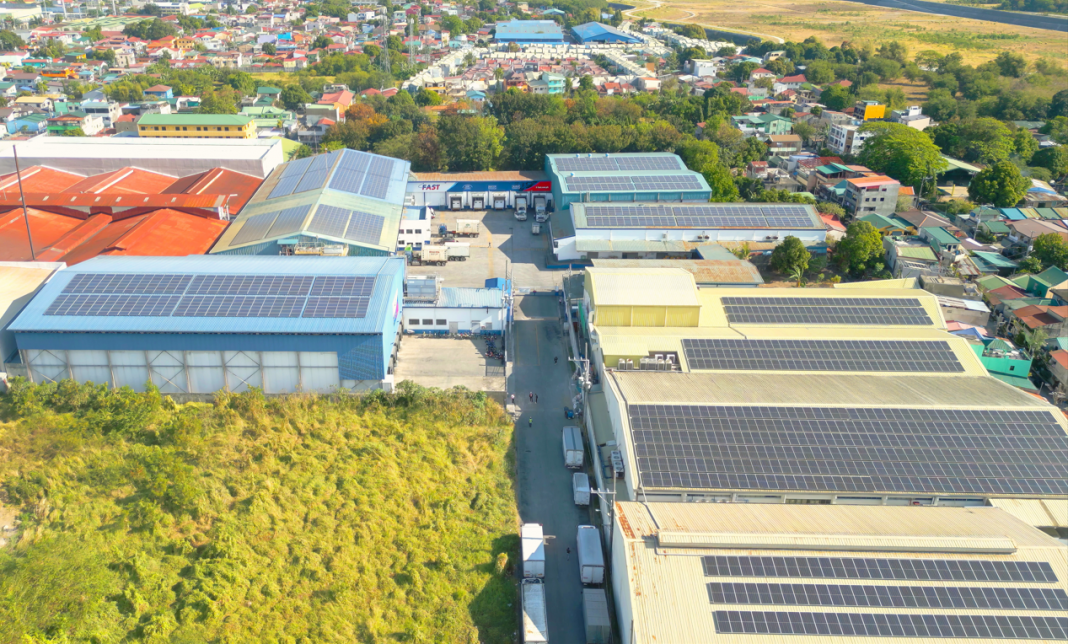
FAST’s solar power roadmap builds on renewable energy projects already operating in its facilities. At FAST ColdChain Hub Cavite, 1,900 solar panels across 5,035 square meters of roof space generated over 565,000 kilowatt-hours of solar energy in 2025, avoided about 386 metric tons of CO₂ emissions, and delivered millions of pesos in cost savings.
FAST Cabuyao, Laguna Hub has 864 solar panels across 2,660.35 square meters of roof space, producing more than 424,000 kilowatt-hours of solar energy in 2025 while avoiding 289 metric tons of CO₂ emissions.
The Laguna hub also hosts solar-powered EV chargers for its fully electric trucks. From 2024 to 2025, FAST’s EV operations avoided 243.83 metric tons of CO₂ emissions compared with equivalent diesel operations, while generating millions of pesos in cost savings versus diesel-powered transport.
Onrejas acknowledged, however, that industry-wide barriers continue to slow the electrification of Philippine logistics.
These include low warehouse utilization, which reduces electricity demand and limits the ability to maximize solar generation savings; heavy traffic and dwell time that hinder EV utilization and truck turnaround; and the lack of commercial-grade EV charging hubs built specifically for trucks.
Despite these challenges, he emphasized that private-sector-led initiatives can help accelerate the transition and reduce the industry’s carbon footprint.
As the trusted logistics partner of multinational companies, leading conglomerates, international startups seeking a presence in the Philippines, and micro, small, and medium enterprises, FAST said sustainability is becoming a stronger business imperative across customer supply chains.